

Arthur’s Hill is a historic residential district in west Newcastle upon Tyne, positioned north of Westgate Road and close to Newcastle General Hospital. Its identity comes from Victorian terraced housing, immigrant communities, independent businesses, strong transport connections and a location close to Newcastle city centre.
- What is Arthur’s Hill and how did it become a residential district?
- When were Arthur’s Hill’s main houses and streets built?
- How much does it cost to rent in Arthur’s Hill Newcastle?
- What type of rental homes can you find in Arthur’s Hill?
- Is parking difficult in Arthur’s Hill?
- How close is Arthur’s Hill to Newcastle city centre?
- What is the local vibe of Arthur’s Hill?
- What historic landmarks can renters find around Arthur’s Hill?
- How did industry and urban growth shape Arthur’s Hill?
- How has Arthur’s Hill changed since the Victorian period?
- What should renters check before choosing a home in Arthur’s Hill?
- Why does Arthur’s Hill remain important to Newcastle’s heritage?
- What does renting in Arthur’s Hill mean for the future?
The area also has an unusually clear connection between present-day renting and Newcastle’s nineteenth-century urban expansion. Arthur’s Hill developed as a planned residential estate during the nineteenth century, replacing parts of an earlier landscape of estates, farms and open land with dense terraces designed for a growing industrial city.
Newcastle City Council’s Historic Environment Record identifies Arthur’s Hill as an area of surviving terraced housing. The council records that Isaac Cookson developed an estate opposite Westgate Hill Cemetery in 1826 and named it after his first son, Arthur. The earliest streets were named after his other sons, John, Edward and William. Those original streets have since disappeared, but much of the later terrace development remains.
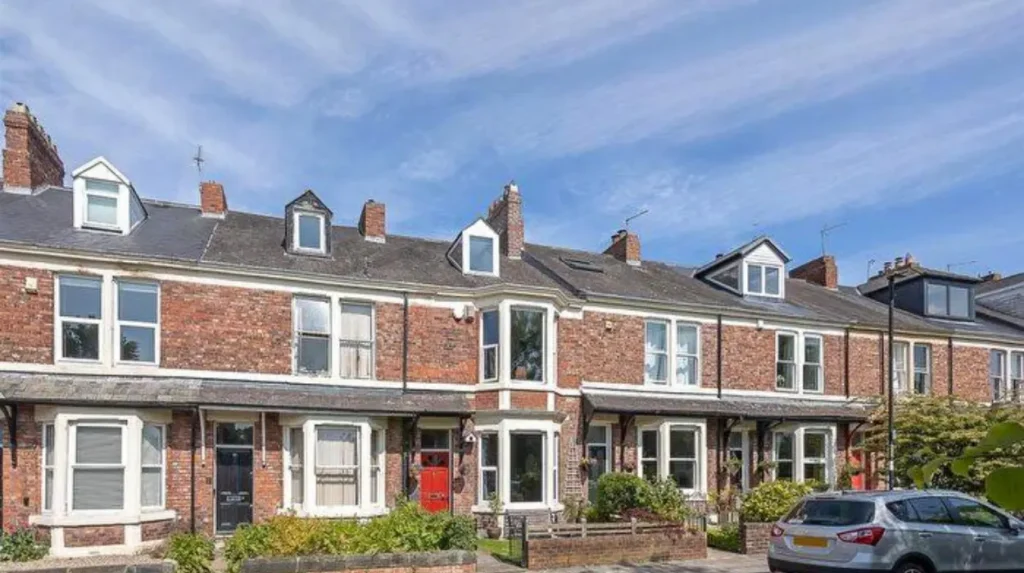
For renters, this history is visible in the housing itself. Two-storey brick terraces, attic rooms, slate roofs, brick chimneys, sandstone detailing, bay windows and traditional street layouts remain important features of the district. The area also contains commercial premises, flats and later twentieth-century housing.
Current rental conditions sit within a wider Newcastle market that has experienced strong rental growth. The Office for National Statistics reported an average private rent of £1,207 per month in Newcastle upon Tyne in July 2026, up 9.8% from £1,100 in July 2025. That figure covers the whole local authority and should not be treated as an Arthur’s Hill average.
What is Arthur’s Hill and how did it become a residential district?
Arthur’s Hill is a west Newcastle residential district created largely through nineteenth-century urban expansion, with its name dating from Isaac Cookson’s 1826 estate. Victorian terraces later became its dominant built form as Newcastle’s population and industrial economy expanded.
Arthur’s Hill occupies elevated ground above the central and western parts of Newcastle. Its position helped shape both its historical development and its present-day character.
The district lies north of Westgate Road, south of Studley Terrace and east of Newcastle General Hospital. The Newcastle Historic Environment Record describes it as an area on a hill overlooking the city.
The name dates to the early nineteenth century. Isaac Cookson developed an estate opposite Westgate Hill Cemetery in 1826 and named it after his first son, Arthur. This provides a documented explanation for the place name rather than relying on later local tradition.
Arthur’s Hill subsequently became part of a much larger wave of urban growth. Newcastle expanded rapidly during the nineteenth century as coal, engineering, manufacturing, shipping and associated trades generated employment and population growth.
The surrounding landscape also contained substantial private estates and individual houses before dense residential development took over. Gloucester House, for example, stood in grounds on the north side of Westgate Road. By the late nineteenth century it had become surrounded by Arthur’s Hill’s terraced streets before being demolished and replaced by a school.
The transformation illustrates a wider process in Newcastle’s urban history. Large houses and open land gradually gave way to streets, terraces, schools, commercial premises and public facilities.
For renters today, that process explains why Arthur’s Hill contains a dense mixture of historic terraces and later redevelopment rather than one uniform housing style.
When were Arthur’s Hill’s main houses and streets built?
Most of Arthur’s Hill’s surviving traditional housing dates from the nineteenth century, with terraced streets clearly established by the 1890 Ordnance Survey map. The surviving buildings show different architectural treatments because separate builders developed individual streets at different times.
The Historic Environment Record identifies surviving terraces across Arthur’s Hill and notes that they were already present by the second edition Ordnance Survey map of 1890. These houses generally have two storeys plus attics, dormer windows, slate roofs and brick chimneys.
The architectural details vary between streets.
Gainsborough Grove and Brighton Grove include houses with bay windows. Sidney Grove contains properties with more decorative architectural treatment. Studley House and Oxley House on Studley Terrace feature decorative sandstone lintels, while Studley House has a prominent corner turret. Some houses also retain porches.
This variation is significant when assessing rental property. Two houses in the same general district can have very different internal layouts, extensions, alterations and maintenance requirements because their original construction was not completely standardised.
Some properties were built as conventional terraces, while others developed into Tyneside flats. Tyneside flats are a distinctive regional housing form in which separate dwellings occupy different floors of the same terrace building.
Arthur’s Hill therefore provides a strong example of how Newcastle’s industrial-era housing stock continues to influence the modern private rental market.
Historic fabric also affects the visual character of streets. Brick façades, sandstone details, bay windows and traditional rooflines remain visible despite later alterations.
Renters assessing an older property should therefore distinguish between historic appearance and modern condition. The age of a building does not by itself indicate the quality of insulation, heating, plumbing, windows, roofing or electrical systems.
How much does it cost to rent in Arthur’s Hill Newcastle?
Arthur’s Hill does not have a single official average rent, but current listings show substantial variation by property size and type. Newcastle’s official July 2026 average was £1,207 per month, while individual Arthur’s Hill listings demonstrate a much wider local range.
Rental costs in Arthur’s Hill depend heavily on the size, condition and location of a property.
Recent advertised examples provide useful market context. A two-bedroom ground-floor flat on Dilston Road was advertised at £850 per month in September 2026. A four-bedroom terraced property at Belsay Place was advertised at £1,400 per month, while a larger five-bedroom terraced property on Brighton Grove was advertised at £2,000 per month.
Another recent listing showed a three-bedroom upper flat on Stanhope Street advertised at £800 per month. The property was described as unfurnished and close to amenities and Newcastle city centre.
These listings demonstrate why a single “Arthur’s Hill rent” figure would be misleading. A renter comparing properties should consider bedrooms, floor area, furnishing, heating system, condition, parking arrangements and tenancy terms.
The wider Newcastle market provides the official benchmark. ONS figures show that average private rent in Newcastle upon Tyne reached £1,207 per month in July 2026. The North East average was £783, while the UK average was £1,393. Newcastle’s annual rental increase was 9.8% between July 2025 and July 2026.
The local listings show that smaller flats and traditional upper-floor properties can sit below the citywide average. Larger houses designed for families or shared occupation can sit above it.
Renters should also calculate the full monthly housing cost rather than focusing only on advertised rent. Council tax, energy, broadband, contents insurance and transport all affect the practical cost of living.
The strongest comparison is between similar properties in the same streets. A two-bedroom flat should be compared with other two-bedroom flats rather than with the Newcastle-wide average.
Rental advertisements also change quickly. Asking prices represent current market listings, not guaranteed achieved rents.
What type of rental homes can you find in Arthur’s Hill?
Arthur’s Hill contains a mixture of traditional terraced houses, Tyneside flats, upper-floor flats and larger converted or adapted properties. The housing stock reflects nineteenth-century expansion followed by later changes to occupation, layout and residential density.
Traditional terraced houses remain one of the defining housing types.
The Newcastle Historic Environment Record identifies brick terraces with two storeys plus attics, dormer windows, slate roofs and brick chimneys. Sandstone quoins and decorative stonework appear on some properties.
Tyneside flats form another important category. These properties are characteristic of Newcastle and the wider North East and often occupy different floors within traditional terraces.
Modern rental listings also include conventional flats. Recent advertisements show two-bedroom and three-bedroom flats within the Arthur’s Hill area, including properties on Dilston Road and Stanhope Street.
Larger terraced houses also appear in the rental market. Brighton Grove and Belsay Place provide examples of larger properties suitable for families or shared accommodation.
The historical building stock creates practical differences between homes. Older properties can have tall ceilings, traditional windows, narrow staircases, attic spaces and unusual room arrangements.
Prospective tenants should inspect the physical condition carefully. Important checks include damp, roof condition, window performance, heating controls, boiler age, electrical installation, insulation and ventilation.
The external appearance of a historic terrace provides useful information about architectural character but does not establish the current condition of the interior.
Is parking difficult in Arthur’s Hill?
Parking in Arthur’s Hill is shaped by dense nineteenth-century terraces, narrow residential streets and limited off-street space. Renters should check the exact property for a driveway, garage, allocated bay, permit requirements and nearby legal parking before signing a tenancy.
Parking is an important consideration because Arthur’s Hill developed during an era when private cars did not exist.
The district’s nineteenth-century terraces were designed around pedestrian movement, horse-drawn transport and dense residential development. Individual properties therefore often lack the driveways and private garages associated with later suburban housing.
Street width and building density vary between roads. A property that appears to have convenient roadside parking during a daytime viewing can have different conditions in the evening.
Renters should inspect parking at several times before committing to a property. Evening conditions provide a better indication of residential demand than a quiet weekday afternoon.
The tenancy advertisement should also be checked for precise wording. “On-street parking” does not mean that a private space is guaranteed. “Permit parking” carries different implications from a property with a dedicated driveway or garage.
Parking arrangements should be confirmed directly with the landlord or letting agent and checked against current Newcastle City Council restrictions where applicable.
Historic street layouts also explain why adding private parking spaces can be difficult. Converting front gardens into driveways affects drainage, kerbs, pedestrian access and the architectural appearance of terraces.
Parking therefore forms part of the wider relationship between historic urban design and modern residential requirements.
For renters who do not need a car every day, Arthur’s Hill’s location provides another option. Its proximity to Westgate Road, Stanhope Street and central Newcastle reduces dependence on private vehicle travel for many everyday journeys.
How close is Arthur’s Hill to Newcastle city centre?
Arthur’s Hill is close to Newcastle city centre and sits beside major routes including Westgate Road. Its elevated position places residents within a densely connected west-central part of Newcastle with shops, services, public transport and employment destinations nearby.
Location is one of Arthur’s Hill’s strongest practical characteristics.
Westgate Road forms a major route through west Newcastle. Stanhope Street functions as a local commercial street and contains shops and restaurants, according to the Newcastle Historic Environment Record.
Recent rental advertisements also highlight access to Newcastle city centre. A Stanhope Street three-bedroom flat was marketed with a stated five-minute journey to the city centre.
The area also sits close to Newcastle General Hospital, making its location relevant to healthcare workers and visitors.
Transport accessibility should nevertheless be assessed at the individual property level. A short journey by vehicle does not necessarily represent the same journey by foot, bicycle or public transport.
Arthur’s Hill’s position on elevated ground is another practical feature. Walking routes can involve noticeable slopes, particularly when travelling between higher residential streets and lower parts of the city.
The historic relationship with Westgate Road remains important. The road developed as part of Newcastle’s westward expansion and became an important commercial and transport corridor.
For visitors interested in connecting the area’s historic streets with present-day attractions, consult our comprehensive for itineraries and visiting parameters.
This link should be replaced with the exact Newcastle Times visitor-guide anchor and URL before publication.
What is the local vibe of Arthur’s Hill?
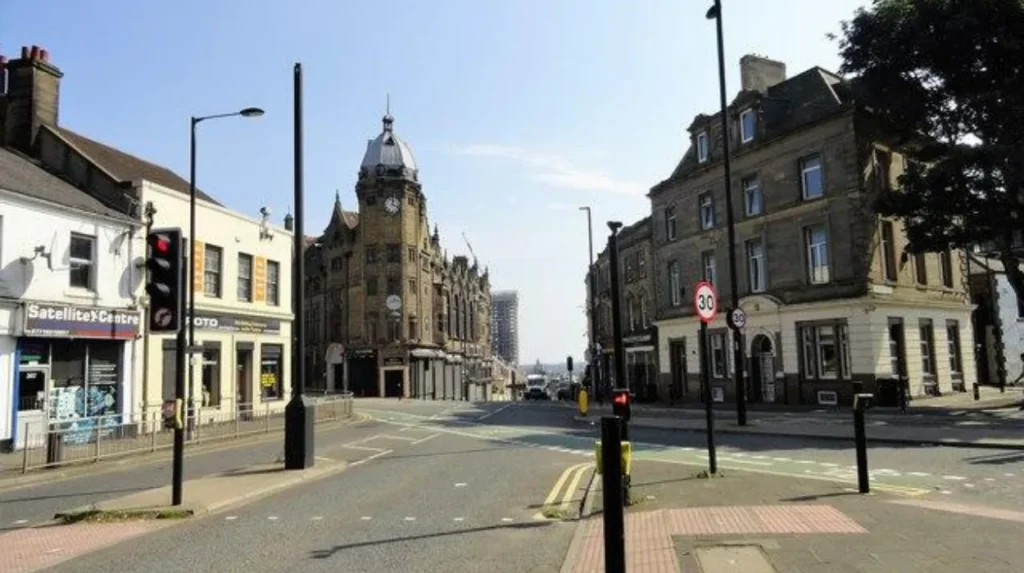
Arthur’s Hill has a dense, multicultural and community-focused urban character shaped by historic terraces, independent businesses, religious and community institutions, busy streets and proximity to Newcastle city centre. Its identity reflects both industrial-era housing and contemporary urban life.
Arthur’s Hill has a strong local commercial identity.
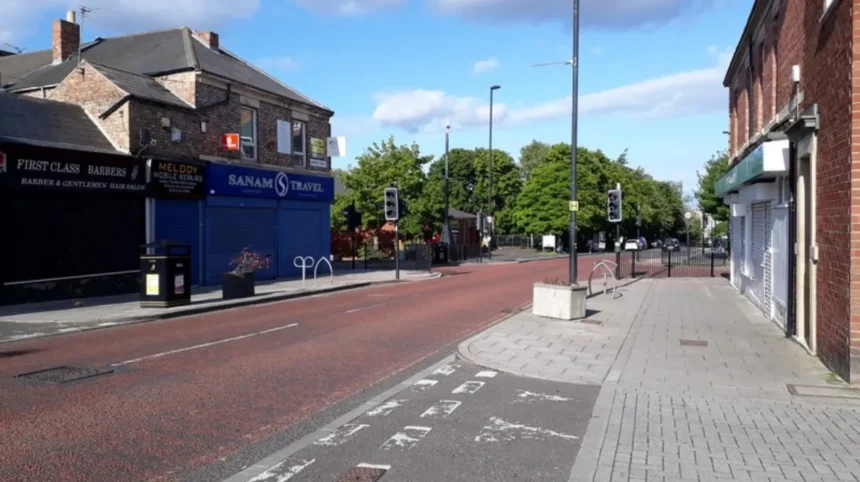
Stanhope Street is identified by Newcastle’s Historic Environment Record as the commercial street, with shops and restaurants occupying the traditional urban fabric.
The area’s population is also diverse. Census-based data for the Arthur’s Hill ward recorded 13,276 residents and 3,628 households in 2021, with 3,611 residents identifying within the Asian, Asian British or Asian Welsh ethnic group. The same dataset records substantial Bangladeshi, Indian and Chinese communities.
These figures help explain the variety of businesses, food outlets, cultural connections and community activity found around the district.
The local character is therefore not solely a product of Victorian architecture. It has been continually reshaped by migration, family settlement, entrepreneurship, education, employment and changes in housing use.
The area also forms part of a wider west Newcastle heritage landscape. Newcastle City Council’s West Newcastle Picture History Collection contains more than 20,000 photographs and documents covering areas including Arthur’s Hill, Benwell, Elswick, Fenham and Scotswood.
This collection provides an important research resource for understanding how streets and communities changed from the nineteenth century to the present.
For renters, the practical result is a neighbourhood where historic buildings and contemporary community life exist side by side.
What historic landmarks can renters find around Arthur’s Hill?
Arthur’s Hill is surrounded by significant heritage sites linked to Victorian urban growth, burial reform, industry, public recreation and housing. Westgate Hill Cemetery, the surviving terraces, Arthur’s Hill Brewery site and nearby Elswick Park provide clear examples.
Westgate Hill Cemetery is one of the most important historic sites associated with Arthur’s Hill.
It opened in 1829 and was established by the Westgate Hill Cemetery Company. Newcastle’s Historic Environment Record identifies it as Newcastle’s first commercial cemetery and one of the first ten commercial cemeteries in England.
The cemetery responded to pressure on burial space and overcrowded churchyards during a period when Newcastle faced serious public-health challenges.
Architect John Green and landscape gardener William Falla were commissioned to lay out the cemetery. The site included winding paths, planted areas, trees and shrubs. Land was acquired for £1,500 in 1828.
The cemetery therefore represents a wider nineteenth-century change in attitudes towards burial, sanitation and planned urban landscapes.
Arthur’s Hill Brewery provides another link with the district’s industrial history. The brewery on Bell Street and Westgate Road was built by a Mr Burdess and passed to John Meikle in 1870. Its documented facilities included brewing equipment, fermentation space, hop stores and a brewer’s office.
Nearby Elswick also provides important historical context.
Elswick Park dates from 1881 and originally formed part of the grounds of Elswick Hall. The hall was demolished in the 1980s. The park was refurbished in 2007, followed by a community garden in 2009 and a community orchard in 2011.
These sites show how the area changed from private estates and industrial development to public recreation and community facilities.
How did industry and urban growth shape Arthur’s Hill?
Industrial growth transformed the wider west Newcastle landscape by creating employment, attracting workers and encouraging dense residential development. Arthur’s Hill’s terraces formed part of this expansion, while nearby breweries, engineering sites, transport routes and public facilities supported the growing urban economy.
Arthur’s Hill cannot be separated from Newcastle’s industrial development.
The wider Fenham, Spital Tongues and Elswick landscape contained industries including the Arthur’s Hill Brewery and other manufacturing enterprises. Newcastle’s Historic Environment Record states that industrialisation encouraged development as a residential district for workers, managers and owners.
This created a clear relationship between employment and housing.
Workers needed homes close to employment areas and transport routes. Developers responded by building dense terraces capable of accommodating large urban populations.
The resulting housing pattern differed from the spacious estates of earlier periods. Terraced streets created high residential density while maintaining direct access to roads and commercial premises.
Public infrastructure expanded alongside housing.
Schools, churches, libraries, baths and recreational facilities formed part of the urban landscape. These institutions helped transform newly developed streets into established communities.
The history also explains the contrast between individual grand houses and dense terraces. Earlier estates such as Gloucester House occupied substantial grounds, but the surrounding land was eventually absorbed by urban development.
This pattern repeated across nineteenth-century Newcastle.
The modern rental market inherits this historical geography. Properties that were originally built for industrial-era households now serve students, professionals, families and other tenants.
How has Arthur’s Hill changed since the Victorian period?
Arthur’s Hill has experienced continuous change rather than remaining a fixed Victorian district. Terraced housing survived, while individual buildings disappeared, properties changed use, new flats appeared and surrounding public spaces were redeveloped during the twentieth and twenty-first centuries.
The district’s built environment records several layers of change.
The earliest streets associated with Isaac Cookson’s 1826 estate have disappeared and were replaced by blocks of flats. Later Victorian terraces survived in greater numbers.
Some historic buildings also changed use.
Traditional houses gained shopfronts and commercial functions. Others became Tyneside flats. Large houses such as Gloucester House disappeared as land was redeveloped for institutional purposes.
Nearby Elswick experienced significant twentieth-century redevelopment.
Cruddas Park, for example, became a major post-war residential development. A bronze abstract sculpture by Ken Ford was unveiled there in 1962 as part of the landscaping scheme for six high-rise blocks around an open space. It was removed in 1975 for repairs and was never returned.
Elswick Park also demonstrates changing approaches to public space. The park’s twentieth-century decline was followed by major refurbishment in 2007, a community garden in 2009 and a community orchard in 2011.
These changes are important for understanding present-day Arthur’s Hill.
A renter is not simply occupying a Victorian house. The property forms part of a layered urban landscape shaped by industrialisation, post-war planning, demographic change and modern regeneration.
What should renters check before choosing a home in Arthur’s Hill?
Renters should assess the property’s condition, exact parking arrangements, heating costs, tenancy terms, council tax, transport connections and street environment. Historic appearance should be considered alongside practical building performance and the specific conditions of each rental agreement.
The first priority is the property itself.
Older terraces require careful inspection because construction methods differ from modern housing. Check windows, roof condition, gutters, external brickwork, damp, ventilation and insulation.
Heating is another important cost.
A property with poor insulation can have significantly higher energy requirements than a similar-sized modern flat. Tenants should ask for the property’s Energy Performance Certificate and examine the heating system before signing.
Parking requires equal attention.
Ask whether parking is private, allocated, unrestricted or controlled by local restrictions. Do not treat an estate agent’s general statement about “street parking” as confirmation of a dedicated space.
The location of the property also matters.
A house close to Stanhope Street provides a different daily experience from a property farther uphill or closer to Westgate Road. Noise, traffic, footfall and access to shops can vary considerably between streets.
Tenants should also compare advertised rent with the wider Newcastle market. The ONS July 2026 figure of £1,207 per month provides a citywide benchmark, but individual Arthur’s Hill listings demonstrate that actual asking rents vary significantly by property type.
Rental applicants should verify deposits, tenancy length, permitted occupants, furnishing status and landlord responsibilities through the letting documentation.
The property viewing should also include the immediate surroundings. Examine pavements, street lighting, traffic, parking pressure, nearby shops and the route to public transport.
This approach provides a more accurate picture than judging the property from photographs alone.
Why does Arthur’s Hill remain important to Newcastle’s heritage?
Arthur’s Hill remains historically important because its surviving terraces preserve evidence of nineteenth-century urban expansion, while its businesses, communities and public spaces demonstrate how historic neighbourhoods continue to evolve within modern Newcastle upon Tyne.
Arthur’s Hill provides a concentrated example of Newcastle’s urban history.
Its development connects private estate building, Victorian housing, industrial employment, public health, commercial activity and demographic change.
The survival of terraced streets is particularly important. Newcastle’s Historic Environment Record documents the architectural features and development history of the district, providing a formal heritage record for researchers and residents.
The surrounding heritage landscape adds further context.
Westgate Hill Cemetery records the development of nineteenth-century commercial burial grounds. Arthur’s Hill Brewery records local industrial activity. Elswick Park records the conversion of private estate land into public recreation. The West Newcastle Picture History Collection preserves more than 20,000 photographs and documents relating to the wider area.
The area also demonstrates the importance of recording ordinary buildings.
Historic significance does not depend exclusively on monumental architecture. Rows of houses, shops, schools, cemeteries and public spaces reveal how people lived and how cities expanded.
Newcastle City Council currently recognises heritage conservation as part of managing change within the city. The council operates conservation and historic-environment services covering archaeology, listed buildings, conservation areas and related heritage issues.
Arthur’s Hill’s continuing residential use gives this heritage a practical dimension.
The same terraces that document Newcastle’s nineteenth-century expansion now form part of the private rental market. Their continued occupation keeps historic streets integrated into everyday urban life.
For renters, this means Arthur’s Hill offers more than proximity to Newcastle city centre. It provides access to a neighbourhood whose streets, buildings and institutions record major stages in the development of west Newcastle.
What does renting in Arthur’s Hill mean for the future?
Renting in Arthur’s Hill combines relatively accessible urban housing with a historically significant built environment and strong links to central Newcastle. Future demand will remain closely connected to rental affordability, housing condition, transport, community facilities and heritage management.
Arthur’s Hill enters the future with a substantial inherited housing stock and a changing rental market.
The ONS reported that Newcastle’s average private rent increased by 9.8% between July 2025 and July 2026. This demonstrates the importance of monitoring current asking prices rather than relying on historical rental assumptions.
The district’s historic housing will remain an important part of that market.
Victorian terraces provide a distinctive supply of homes close to the city centre. Their continued use depends on appropriate maintenance, energy improvements and adaptation to modern household requirements.
The local population also contributes to the area’s identity. The 2021 Census recorded 13,276 residents in the Arthur’s Hill ward, demonstrating the scale of the community surrounding the historic housing stock.
Heritage management will remain relevant as buildings are repaired, altered or converted.
Newcastle City Council’s historic-environment work recognises the need to protect significant architectural and historic character while managing necessary urban change.
For prospective renters, the result is a neighbourhood where cost, parking and lifestyle cannot be separated from history.
A typical Arthur’s Hill terrace is part of a housing system created during Newcastle’s nineteenth-century expansion. A local shop reflects the continuing commercial role of the district. Westgate Hill Cemetery records changing approaches to public health and burial. Nearby parks demonstrate later investment in public recreation.
Arthur’s Hill therefore remains a useful case study in how historic neighbourhoods function as living parts of modern cities.
For anyone comparing Newcastle rental areas, the essential picture is clear: Arthur’s Hill combines historic terraced housing, varied rental prices, constrained parking, strong local commerce, diverse communities and close access to central Newcastle. Its value lies in the combination of practical urban living and a built environment that preserves visible evidence of the city’s industrial and social development.