


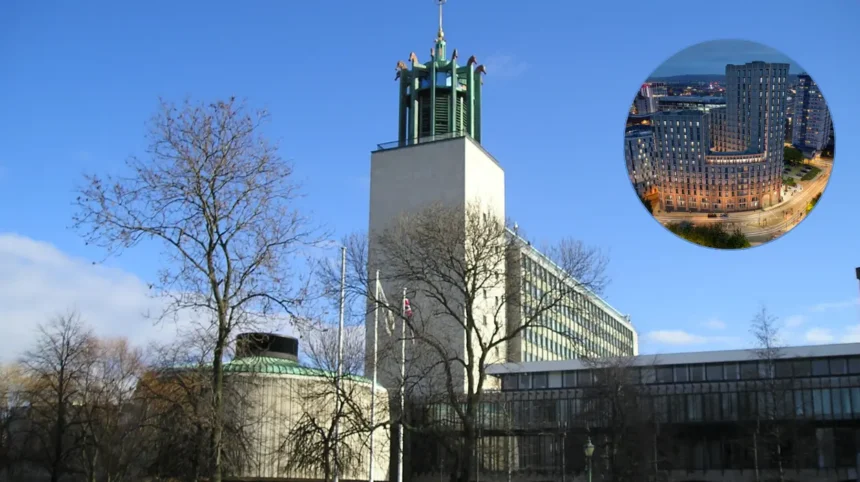
Key Points
- Plans worth £60 million to build student accommodation in Newcastle city centre have been approved by the Newcastle City Council’s planning committee.
- It involves knocking down the empty offices of Hadrian House and constructing two blocks of student accommodation.
- The tallest block will be 21 storeys high, which would make it among the tallest structures in Newcastle.
- The second block will be 14 storeys high.
- The development will offer 507 student bed spaces and create a rejuvenated public area that will include parts of the Saville Place car park.
- The decision in favour of giving planning permission was taken on a four-to-three vote.
- The development is being undertaken by Sona Estates and Argon.
- Suzanne Hydes, a resident, has called the development “gargantuan” and highlighted the issue of overshadowing, healthcare pressure and impact on the cityscape.
- There were also concerns that there could be underground gas contamination due to the workings of the mines underneath the building site.
- The director of Argon, Richard Wilks, said that the contamination problem was a construction problem since the foundation will go up to 15 metres deep whereas historical workings are located at a depth of 100 metres.
- On the other hand, supporters suggested that the development project will compensate for the loss of students’ accommodation after the closure of Claude Gibb and Lovaine halls of residence.
- Councillors also discussed whether the project should be a part of the wider New Bridge Street regeneration programme.
- The chair of the committee, Doreen Huddart, described the current Hadrian House as an eyesore, although she voted against the project, considering it to be too high.
- It will take six months to demolish the building, while its construction will last for two-and-a-half years.
- The building construction will start in October 2027.
- This decision was postponed due to the new planning policy introduced by the Government for the local councils.
Newcastle (Newcastle Times) September 4, 2026 — Newcastle City Council’s planning committee has narrowly approved plans for a £60 million student accommodation development that would transform the vacant Hadrian House site with two new towers containing 507 bedrooms.
- Key Points
- What has Newcastle City Council approved for Hadrian House?
- Why has the Hadrian House redevelopment attracted controversy?
- What did residents say about the proposed height and surrounding buildings?
- What did the developers say about the £60m project?
- Why is student accommodation such an important part of the proposal?
- What were the concerns about underground gas contamination?
- Which Newcastle councillors opposed the scheme?
- Why did some councillors support the Hadrian House plans?
- Why did the planning committee chair vote against the proposal?
- What will happen to Hadrian House before construction begins?
- When could the new Newcastle student accommodation be completed?
- Why was the planning decision previously delayed?
- What does the approval mean for Newcastle city centre?
The committee voted four to three in favour of the scheme, allowing developers Sona Estates and Argon to proceed with proposals to demolish the existing 1970s office building and associated high-level walkways. The replacement scheme will feature a 21-storey tower alongside a 14-storey building, together creating a major new student accommodation complex on the eastern side of Newcastle city centre.
The decision follows a contentious planning hearing in which councillors, residents and developers presented sharply different views of what the project would mean for the area. While supporters described the redevelopment as a major opportunity to regenerate an underused part of the city, opponents questioned whether the scale of the proposed towers was appropriate for their surroundings.
The development is expected to take several years to complete. Demolition of Hadrian House is expected to last about six months, while construction of the replacement buildings is expected to take around two-and-a-half years. Work is currently scheduled to begin in October 2027.
Chronicle Live previously reported on the £60 million proposal and described the planned replacement as a major regeneration project involving a 21-storey student accommodation tower. Its August report said councillors were being asked to consider the demolition of the vacant Hadrian House and the construction of the new student scheme.
What has Newcastle City Council approved for Hadrian House?
The approved project will replace Hadrian House with two purpose-built student accommodation towers. The larger building will rise to 21 storeys, while the second will reach 14 storeys.
The development will provide 507 student bedrooms, together with a new public space designed to improve the setting around the site. Part of the existing Saville Place car park will be incorporated into the regenerated public realm.
Hadrian House has stood as a prominent example of Newcastle’s 1970s office architecture but has remained vacant. The proposals would therefore replace an unused commercial building with accommodation aimed specifically at Newcastle’s growing student population.
The scheme also includes the removal of several elevated walkways around Hadrian House. These structures have been described in the planning discussions as underused and unwelcoming, meaning their removal is intended to alter not only the building itself but also the pedestrian environment surrounding the site.
The proposal had already attracted attention because of the height of the proposed main tower. A previous report by Chronicle Live said the project was being considered as part of a £60 million regeneration vision for the vacant Hadrian House site.
Why has the Hadrian House redevelopment attracted controversy?
The central dispute has been the scale and visual impact of the proposed development.
Residents and some councillors argued that a 21-storey building would be too dominant for the location and could change the character of the surrounding area. The height became one of the most important issues during the planning committee’s consideration.
Suzanne Hydes, a resident of neighbouring Bewick Court, was among those raising objections. She described the proposed building as “gargantuan”, expressing concern about its potential impact on nearby residents and the surrounding cityscape.
Hydes also warned that the development could create additional pressure on local healthcare services because of the significant number of students expected to occupy the new accommodation.
She argued that the scheme would “irrevocably alter” the cityscape and raised concerns about the relationship between the proposed towers and nearby listed buildings, including the Laing Gallery.
The concerns illustrate the wider planning debate surrounding tall buildings in established city-centre areas: while higher-density development can provide more accommodation without spreading into wider areas, its height and mass can have a significant effect on views, neighbouring properties and heritage assets.
What did residents say about the proposed height and surrounding buildings?
The proposed 21-storey tower became a particular concern because of its relationship with nearby buildings and public spaces.
Hydes argued that the scale of the development could lead to overshadowing for surrounding properties. Her objection was not limited to the number of floors but also focused on how a large student population and tall building would interact with the existing neighbourhood.
She also highlighted the potential impact on the city’s architectural setting, particularly the relationship with nearby listed buildings.
The concerns over the Laing Gallery reflect the wider question of how Newcastle should accommodate modern development while protecting the character of established parts of the city centre.
The planning committee therefore had to weigh the benefits of replacing an empty office block and providing student housing against objections relating to height, visual impact, overshadowing and the wider character of the area.
The final four-three vote demonstrates how closely divided the committee was over the proposal.
What did the developers say about the £60m project?
Argon director Richard Wilks defended the scheme and presented it as an opportunity to regenerate an underused part of Newcastle.
Wilks described the proposal as a “generational opportunity” and said the development could act as a catalyst for regeneration around the city’s eastern gateway.
He said:
“We believe this is a generational opportunity to make a positive difference to this part of the city and act as a catalyst for the regeneration of this part of the city and its eastern gateway.”
The developers’ argument centres on the existing condition of the Hadrian House site. Rather than retaining an empty office building and its surrounding infrastructure, the proposal would introduce a large-scale residential development specifically designed for students.
The scheme would also create a new public space, giving the project an element beyond the accommodation itself.
The developers have positioned the project as part of the continuing evolution of Newcastle city centre, where demand for student accommodation has become an important consideration in planning decisions.
Why is student accommodation such an important part of the proposal?
Wilks said the development would effectively serve as an extension of the Northumbria University campus.
He also pointed to the loss of university-owned student accommodation following the closure of Claude Gibb and Lovaine halls of residence.
According to the developers, the new scheme would help compensate for the loss of hundreds of university-owned bedrooms and provide additional accommodation close to the university and city centre.
The proposal’s 507 bedrooms therefore form a central part of the argument in favour of the development. Newcastle has a large student population, and providing accommodation close to educational institutions can reduce pressure on other parts of the housing market.
However, the scale of the project means that its benefits are being considered alongside questions about the effect of hundreds of additional students living in one location.
That tension was reflected in the planning debate, with supporters focusing on the city’s accommodation requirements while opponents concentrated on the local impact of the proposed development.
What were the concerns about underground gas contamination?
Environmental and ground conditions also featured in the objections.
Hydes raised concerns about possible underground gas contamination and argued that a detailed investigation should be completed before planning permission was granted.
The concern relates to historic mining activity beneath the site. Wilks acknowledged the presence of historic mine workings but said the developers did not regard the issue as a risk to the public.
He explained that historic mine workings are located roughly 100 metres beneath the site, while the foundations of the proposed building would extend to approximately 15 metres before reaching bedrock.
Wilks said a more detailed ground survey could only be undertaken once Hadrian House had been demolished.
He characterised the contamination issue as a
“construction issue rather than there being a risk to the public”.
The distinction is important to the planning debate because the developers maintain that the underground conditions can be addressed as part of the construction process rather than representing a current danger to people living or working nearby.
The issue nevertheless formed part of the concerns raised by residents during the hearing.
Which Newcastle councillors opposed the scheme?
The committee’s discussion also exposed concerns about the wider regeneration of the surrounding New Bridge Street area.
Elswick councillor Peter Thomson expressed frustration that the Hadrian House proposal was not being brought forward as part of a broader regeneration strategy.
His concern was that replacing one building would not necessarily resolve wider problems in parts of the New Bridge Street area.
Green Party councillor John Pearson shared those concerns and described the proposal as “disrespectful to its surroundings”.
Their objections were focused not only on the student accommodation itself but also on the opportunity presented by the site. They questioned whether a £60 million investment should be linked to a wider plan addressing other run-down parts of the surrounding area.
The debate therefore became a question of scale partly: whether the Hadrian House project should be judged as an individual planning application or as part of a much broader regeneration opportunity.
Why did some councillors support the Hadrian House plans?
Not all committee members viewed the existing site or proposed tower negatively.
Liberal Democrat councillor Henry Gallagher argued that the current site was in poor condition and that Newcastle needs more student accommodation.
Gallagher said:
“It is currently an awful space and we saw clearly on the figures that we need more student accommodation. I think it is going to be an absolute improvement on what we have at the moment.”
His position reflected one of the key arguments made by supporters of the project: the existing building is vacant and regarded by some councillors as an eyesore, while the proposed development would put the site back into productive use.
The argument also recognises Newcastle’s position as a major university city, where demand for student accommodation remains an important factor in urban planning.
The developers’ regeneration case and Gallagher’s support therefore placed emphasis on the potential benefits of replacing an unused building with new accommodation and public space.
Why did the planning committee chair vote against the proposal?
Planning committee chair Doreen Huddart also acknowledged the poor condition of Hadrian House but remained opposed to the application.
Huddart described the existing building as an “eyesore”, indicating that she recognised the shortcomings of the current site.
However, she voted against the proposal because of concerns about the height of its replacement.
Her position highlights the difficult balance faced by the committee. Removing an unpopular and vacant building could be viewed positively, but replacing it with a much taller structure creates a separate planning question about whether the proposed scale is appropriate.
The final four-three vote means that the committee approved the project despite the chair’s opposition and objections from other councillors and residents.
What will happen to Hadrian House before construction begins?
The first major physical stage will be the demolition of the existing Hadrian House building and associated elevated walkways.
Demolition is expected to take around six months.
The developers have said that some detailed investigations, including work relating to the site’s ground conditions, can be undertaken more comprehensively after the existing building has been removed.
Once demolition and preparatory work are completed, construction of the two new student accommodation towers is expected to follow.
The current timetable places the start of construction in October 2027, with the building phase expected to take approximately two-and-a-half years.
That means the completed scheme remains several years away, even though planning permission has now been granted.
When could the new Newcastle student accommodation be completed?
The construction programme is expected to last about two-and-a-half years after work begins.
With construction scheduled for October 2027, completion would therefore be expected after the demolition period and the subsequent building programme, subject to the project proceeding according to the current timetable.
The scheme will ultimately consist of the 21-storey and 14-storey towers, providing 507 student bedrooms and a regenerated public area.
The timetable also means that the planning approval marks the beginning rather than the end of the redevelopment process.
Further construction, ground and technical work will be required before the accommodation can open.
Why was the planning decision previously delayed?
The Hadrian House decision had already been delayed before the latest committee meeting.
The delay followed the Government’s publication of new planning rules affecting local councils.
The change meant that the application had to remain under consideration while the implications of the new planning framework were assessed.
The subsequent approval now gives the developers a clear planning decision, although the project still has to move through its demolition and construction phases.
The delay also demonstrates how major urban developments can be affected by changes in national planning policy even when an application is being considered by a local authority.
What does the approval mean for Newcastle city centre?
The decision represents a significant change in direction for a prominent vacant site.
If delivered as proposed, the Hadrian House replacement would introduce one of the city’s more substantial student accommodation developments and add a 21-storey building to the Newcastle skyline.
The 507 bedrooms would increase the amount of dedicated student housing available in the city, while the public-space element would alter the immediate environment around Saville Place.
For supporters, the scheme represents an opportunity to replace an unused office block and contribute to the regeneration of the eastern gateway into the city centre.
For opponents, the central concern remains whether the benefits justify the visual and local impact of a building of this scale.
The narrow vote means the disagreement is not simply a matter of political rhetoric. Three members of the planning committee voted against the proposal, while four backed it.
The development will now move towards the next stages, with demolition and construction forming the next major milestones.
Chronicle Live’s earlier coverage established the proposal as a £60 million regeneration plan involving the demolition of Hadrian House and the creation of a 21-storey student accommodation building. A separate listing of the same August reporting also recorded the planned vote and the proposal’s 21-storey scale.
For Newcastle, the approval places a major new building project on the city’s development timetable. The outcome will depend on whether the scheme proceeds through demolition and construction as planned, but the committee’s four-three decision has now cleared a major planning hurdle.