

Key Points
- The history of the roots of Newcastle United is considered to trace back to four different historic grounds, which were situated in East End areas such as Byker and Heaton.
- Prior to establishing itself in St James’ Park, the club had been functioning as a nomadic institution in the second half of the 19th century, constantly moving to new locations due to expired contracts, pitch wear and tear, as well as a growing number of spectators.
- It should be noted that according to the historical records, football clubs in the late 19th century did not own their playing grounds, instead renting them from local cricket teams.
- In terms of the historical research, it can be seen that St James’ Park survived longer than the other North East football grounds such as Horsley Hill Stadium (South Shields AFC), Redheugh Park (Gateshead FC) and Appleby Park (North Shields FC).
Newcastle (Newcastle Times) September 26, 2026 – Newcastle United’s early beginnings have been traced back to four separate playing sites across the East End neighbourhoods of Byker and Heaton, situated roughly two miles from St James’ Park. In an analysis published by Read Newcastle, journalist Benjamin Mott outlined how the club’s late 19th-century precursor team operated on a nomadic basis due to expiring land leases and a rapidly expanding local support base. The historical examination highlights the contrast between these vanished working-class venues and the century-long endurance of the club’s modern stadium.
Where did Newcastle United play before St James’ Park?
As reported by Benjamin Mott of Read Newcastle, the team that eventually evolved into Newcastle United originally competed in the working-class East End communities of Byker and Heaton during the final decades of the 19th century. During this era, association football was establishing itself as a popular and inexpensive form of entertainment for local industrial workers.
Mott noted that long before settling on the hill above the city centre where St James’ Park stands today, the early club moved between four distinct locations. These venue changes were driven by the practical demands of the period. Because early clubs seldom held title ownership to their pitches, they relied on short-term land leases, borrowed grounds, or shared playing surfaces with regional cricket clubs. Whenever a lease agreement expired, a landlord demanded the return of the property, or the physical surface deteriorated, the club was forced to find a new venue.
How did working-class East End communities shape the early club?
In his reporting for Read Newcastle, Benjamin Mott detailed that the industrial character of Byker and Heaton was central to the creation of the club. Terraced housing, factories, and river shipyards defined daily life on the east side of Newcastle, establishing a demographic base that adopted football as a primary leisure activity.
According to Mott, the team’s initial moves reflected a pattern of constant adaptation to accommodate growing spectator turnouts that exceeded the capacity of smaller, rented pitches. Detailed archival records for each of the four individual East End sites remain scarce; however, historical data confirms that the club’s initial structure was defined by temporary, improvised arrangements rather than a single permanent home.
Explore More Newcastle United F.C. News
Matthias Jaissle Addresses Key Newcastle United Squad Issues on Tyneside 2026
Newcastle Fans Rate Matthias Jaissle Start Season Assessment Newcastle 2026
Which historic North East football grounds have disappeared?
As highlighted by Benjamin Mott of Read Newcastle, Newcastle United’s early venue shifts were part of a wider trend across North East England, where numerous historic football grounds have since been lost. Citing records of regional Tyneside football venues, Mott identified several lost facilities across the region:
- Horsley Hill Stadium: Formerly the home ground of South Shields AFC, this location no longer hosts football matches.
- Redheugh Park: Located across the River Tyne, this venue served as the home stadium for Gateshead FC until its closure around 1971, ending its decades-long association with the sport.
- Appleby Park: A venue along the coast that previously served as the home ground for North Shields FC.
Mott pointed out that none of these historic sites remain active for football today. Their disappearance underscores how common it was for North East grounds to be redeveloped or abandoned as financial and industrial conditions shifted throughout the 20th century.
How does the survival of St James’ Park contrast with regional history?
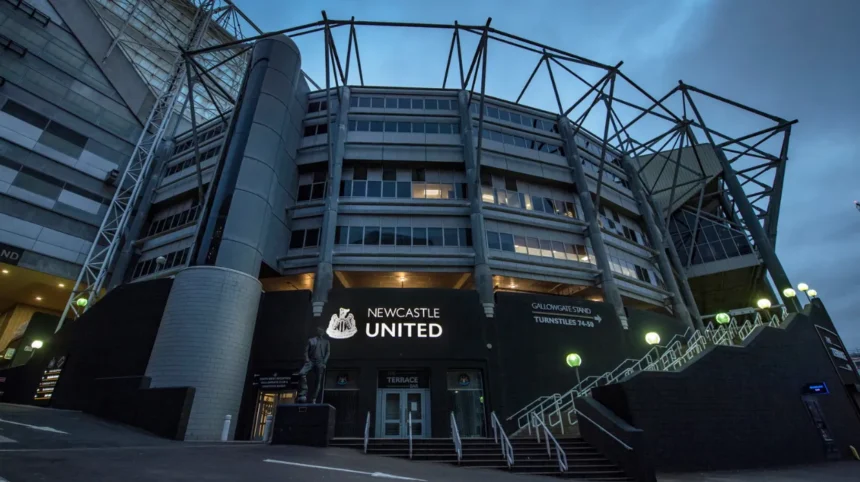
According to reporting by Benjamin Mott of Read Newcastle, the longevity of St James’ Park is notable when measured against the regional loss of other historic sporting grounds. While venues such as Horsley Hill Stadium, Redheugh Park, and Appleby Park completely vanished from the sporting map, St James’ Park has remained continuously active on its city-centre hill for over 100 years.
Mott observed that St James’ Park has survived through multiple eras of the sport, hosting fixtures ranging from wartime matches to modern Premier League campaigns. The contrast between Newcastle’s enduring home ground and the lost East End sites illustrates how rare it was for a 19th-century football site to remain permanently intact into the modern professional era.
Background
The foundational history of Newcastle United is tied to the merger of two local rival teams in the late 19th century: Newcastle East End and Newcastle West End. Newcastle East End FC was originally formed in 1881 as Stanley Football Club by members of a local cricket team in Byker. The club subsequently changed its name to Newcastle East End in 1882 to reflect its local identity, playing across temporary venues in Byker and Heaton as it grew in status.
During the late 1880s and early 1890s, Newcastle East End became a dominant local side, eventually transitioning to professionalism. Meanwhile, Newcastle West End FC had leased St James’ Park in 1886. When Newcastle West End suffered severe financial distress and folded in 1892, Newcastle East End took over the lease of St James’ Park to accommodate its growing fan base. In December 1892, to unite the city’s football supporters under a single banner, the club was officially renamed Newcastle United Football Club.
Prediction
The ongoing historical documentation of Newcastle United’s East End origins is expected to directly influence local heritage groups, football historians, and the wider Newcastle United fanbase.
For local supporters and residents of Byker and Heaton, this detailed focus on early venues will likely increase interest in regional heritage initiatives and site-marking projects. Fans and community historians frequently advocate for blue plaques or commemorative markers at historic sporting locations. Uncovering details about these four original sites could lead to formal local history campaigns aimed at preserving the memory of the club’s working-class origins.
For Newcastle United’s global and domestic supporter base, these historical details reinforce the club’s identity as an institution deeply rooted in Tyneside’s industrial heritage. As modern football undergoes commercialization and stadium expansion debates, documented connections to early East End venues provide supporters with a clear historical framework regarding how the club evolved from a neighborhood side into a major Premier League institution.