

Key Points
- Two Distinct Options: Newcastle United is evaluating two primary pathways for its stadium future: building a brand-new stadium or thoroughly redeveloping St James’ Park.
- New-Build Proposal: As reported by Martin Hardy of The Times, one option involves constructing a 65,000-capacity stadium behind the Leazes End at an estimated cost of £1.5 billion.
- Redevelopment Alternative: The second option focuses on staying at the historic site and expanding St James’ Park to a 60,000-capacity venue for approximately £500 million.
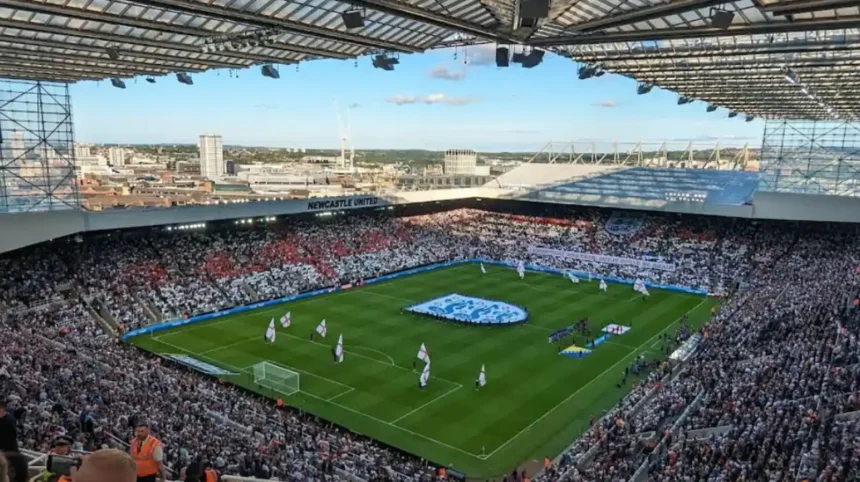
- Capacity Increase: The new-build project would elevate the current capacity by roughly 12,000 seats from the existing 52,700 limit.
- Strategic Expansion: Recent property acquisitions, such as the purchase of Leazes Terrace, provide the club with greater spatial and operational flexibility.
Newcastle (Newcastle Times) October 7, 2026 – Newcastle United’s long-term stadium future hangs in the balance as club decision-makers weigh a monumental choice between relocating to a multi-billion-pound custom facility or preserving their historic home in the heart of the city centre.
How Do the Two Stadium Proposals Compare in Cost and Capacity?
The ongoing evaluation centres heavily on striking the right balance between maximizing commercial revenue, satisfying modern matchday expectations, and protecting the rich heritage tied to St James’ Park. As reported by Martin Hardy of The Times, Newcastle United is actively considering two significantly different pathways.
The first proposal entails building a brand-new 65,000-capacity stadium situated behind the Leazes End. According to Martin Hardy of The Times, this ambitious new-build option comes with a staggering estimated price tag of £1.5 billion. Within this framework, financial projections indicate that Newcastle would need to directly finance roughly £500 million of the total development costs. This ultramodern venue would push capacity up by approximately 12,000 seats, comfortably outstripping the current 52,700 capacity baseline.
The second proposal offers a more traditional and financially conservative route. As detailed by Martin Hardy of The Times, the club could choose to stay put and wholly redevelop St James’ Park to accommodate around 60,000 supporters. This comprehensive renovation alternative would cost significantly less, with early estimates hovering around the £500 million mark.
Why Are These Infrastructure Decisions Crucial for the Club’s Ambitions?
The physical constraints surrounding the current ground have long complicated expansion efforts. Because the stadium sits tightly within a protected urban environment surrounded by listed structures, carrying out major structural upgrades poses unique engineering challenges.
Nevertheless, recent strategic steps have opened up new possibilities. As noted in local reports regarding the club’s administrative maneuvers, the purchase of much of Leazes Terrace has given the hierarchy greater spatial flexibility when assessing their long-term infrastructure options.
A larger, modernized home is viewed by many as vital to keeping pace with ambitious commercial targets. In modern football, maximizing matchday income and corporate hospitality revenues is essential for closing the financial gap separating challenger clubs from established elite competitors. Whether that commercial growth is best achieved through a completely fresh canvas or an innovative overhaul of an iconic arena remains the central dilemma for the club’s leadership.
Background of the Particular Development
The debate surrounding Newcastle United’s stadium infrastructure has accelerated significantly following the club’s high-profile takeover, which brought renewed financial backing and soaring sporting ambitions. For decades, St James’ Park has served as the undisputed heart and soul of the football club, hosting matches on the same site since 1892. However, high demand for tickets, season-ticket waiting lists numbering in the tens of thousands, and the need to maximise commercial streams in line with Premier League financial regulations forced the club’s owners to commission detailed feasibility studies. Early internal data ruled out extreme capacities such as 80,000 seats, steering the club toward more realistic modern thresholds between 60,000 and 65,000 seats. While preliminary architectural concepts and digital visualisations have sparked intense public interest, the project has also navigated local scrutiny, including community discussions regarding the protection of surrounding public green spaces.
Prediction
This pivotal stadium decision will profoundly affect Newcastle United supporters, local residents, and the club’s long-term financial trajectory. For the fans, choosing between a £1.5 billion state-of-the-art facility and a £500 million redevelopment of St James’ Park represents a choice between embracing futuristic commercial growth or preserving the unmatched, historic atmosphere of their traditional city-centre home. If the club opts for a new build, supporters may gain a world-class arena with enhanced amenities, though it risks initial division over heritage loss and potential ownership dilution to fund the massive capital outlay. Conversely, staying at St James’ Park would protect the sacred geographic identity of the club, but could introduce complex logistical hurdles and capacity limitations compared to elite rivals. Ultimately, whichever path the hierarchy selects will define the matchday experience and competitive ceiling of the club for generations to come.