


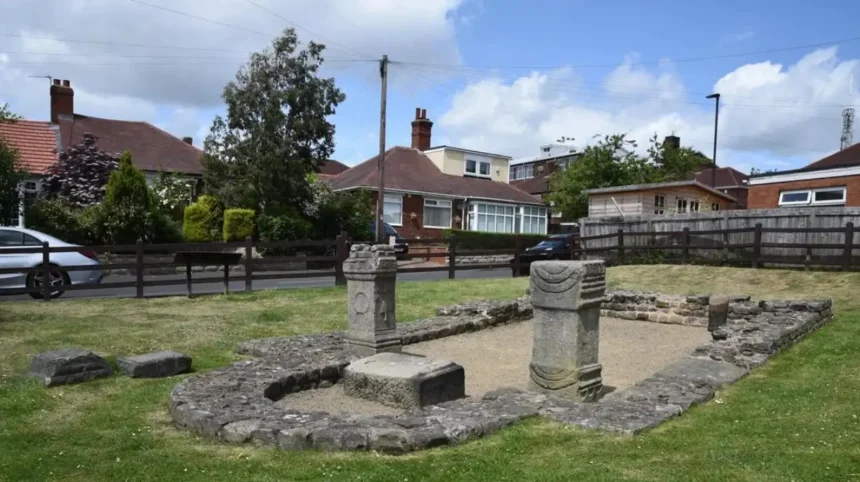
Benwell Roman Temple is an archaeological site in Benwell, Newcastle upon Tyne, associated with the Roman religious landscape of northern Britain. Located near the route of Hadrian’s Wall, the site preserves evidence of Roman worship and military-era life in the area. It offers historical context for understanding how Roman communities practised religion beyond military forts and settlements.
- What Is Benwell Roman Temple and Why Is It Important?
- Where Is Benwell Roman Temple in Newcastle upon Tyne?
- How Do You Get to Benwell Roman Temple?
- When Is Benwell Roman Temple Open, and Is Entry Free?
- Who Was Antenociticus, the God Worshipped at Benwell Roman Temple?
- When Was Benwell Roman Temple Built?
- What Can You See at Benwell Roman Temple Today?
- How Is Benwell Roman Temple Connected to Hadrian’s Wall?
- What Other Roman Sites Can You Visit Near Benwell Roman Temple?
For visitors exploring Newcastle’s Roman heritage, Benwell provides a connection between the modern West End and the ancient frontier established under Emperor Hadrian in the second century AD. The temple is particularly relevant to people interested in archaeology, Roman Britain, local history and the wider Hadrian’s Wall landscape.
Understanding how to visit Benwell Roman Temple requires distinguishing the archaeological remains from nearby Roman sites, identifying the location, checking current access arrangements and planning a route that respects the historic environment.
What Is Benwell Roman Temple and Why Is It Important?
Benwell Roman Temple is an archaeological site in Newcastle upon Tyne associated with Roman religious practice near Hadrian’s Wall. It helps explain the spiritual life of Roman Britain and the archaeological importance of Newcastle’s western frontier landscape.
Roman Britain was the period when much of present-day England and Wales formed part of the Roman Empire, from the conquest beginning in AD 43 until Roman imperial administration ended in the early fifth century. During this period, settlements, roads, forts and religious structures developed across the region.
Benwell Roman Temple belongs to this wider archaeological landscape. Its significance comes from the relationship between Roman religion, the frontier population and the military infrastructure that protected the northern boundary of the empire.
Hadrian’s Wall was constructed under Emperor Hadrian, whose reign lasted from AD 117 to 138. Building began around AD 122. The frontier extended approximately 73 Roman miles, equivalent to about 80 modern miles or 117 kilometres, across northern England between the River Tyne and the Solway Firth.
The wall was not simply a defensive barrier. It formed part of a frontier system that included forts, milecastles, turrets, roads and associated settlements. Religious sites formed another part of this environment, reflecting the beliefs and customs of soldiers, civilians and local communities.
Benwell’s archaeological context therefore extends beyond the temple itself. The surrounding area helps researchers understand how Roman military occupation influenced settlement, movement, religious activity and everyday life in what is now Newcastle’s West End.
The site also contributes to Newcastle’s identity as a modern city with substantial Roman heritage. Visitors who explore the area gain a broader understanding of the history behind the city’s streets, neighbourhoods and regional landscape.
Where Is Benwell Roman Temple in Newcastle upon Tyne?
Benwell Roman Temple stands on Broomridge Avenue in Benwell, Newcastle upon Tyne, Tyne and Wear, with postcode NE15 6QP. The archaeological monument lies in a residential neighbourhood near the A69 and the former Roman fort of Condercum.
The temple is in Newcastle’s western urban area, several miles from the city centre. Unlike many Roman attractions in Northumberland, it sits within a modern residential setting rather than an open countryside landscape.
Benwell is a historic neighbourhood on the western side of Newcastle. Its Roman remains form part of the wider Hadrian’s Wall landscape, which crosses the modern city and extends into Northumberland and Cumbria.
The nearby A69 provides an important geographical reference point. The road runs close to the former Roman fort, whose site is largely covered by later development. The temple itself remains identifiable as a small archaeological monument among houses and local streets.
Visitors should enter the temple’s name and postcode into their navigation app rather than relying on the general location of Benwell. The neighbourhood contains several historic features, and the temple and the separate Vallum crossing have different access points.
How Do You Get to Benwell Roman Temple?
Visitors can reach Benwell Roman Temple by car, bicycle, public transport and local walking routes. Broomridge Avenue provides the direct destination, while Newcastle city centre serves as the main starting point for visitors arriving by train or coach.
Travelling by car
The temple is close to the A69 corridor on Newcastle’s western side. English Heritage identifies on-street parking as possible near the monument. However, the surrounding streets serve residential properties, so visitors should use legal parking spaces and avoid obstructing driveways or pedestrian access.
Before travelling, check the route for current traffic conditions and roadworks. Parking availability depends on local conditions, and the site does not operate as a conventional visitor attraction with a dedicated large car park.
Travelling by bus
Newcastle’s local bus network connects the city centre with western neighbourhoods, including Benwell. The precise service and stop depend on the departure point and timetable in operation on the day of travel.
Use the destination postcode to compare current routes through the local transport operator or a journey-planning app. Check the walking distance between the selected bus stop and Broomridge Avenue before setting off.
Travelling by bicycle
English Heritage identifies bicycle access and links the site to the National Cycle Network. Cyclists should consult a current cycling map for a suitable route from Newcastle city centre or another starting point.
Secure bicycle parking should not be assumed at the monument. Visitors should also take care on roads around the A69 and use designated cycling infrastructure where available.
Travelling on foot
Walking is a practical way to explore Benwell’s Roman remains alongside the surrounding neighbourhood. The route should be planned around pedestrian crossings, pavement conditions and the location of nearby heritage sites.
Visitors coming from central Newcastle should check the full route before choosing to walk, as the temple is outside the immediate city-centre sightseeing area. A short local visit is easier to organise when the journey is combined with another nearby Roman monument.
When Is Benwell Roman Temple Open, and Is Entry Free?
Benwell Roman Temple is an open-access historic monument managed by English Heritage. Official visitor information states that it is open at reasonable times during daylight hours and that entry is free, without standard admission tickets.
Unlike staffed museums, the temple does not follow a conventional daily schedule of timed entry sessions. Daylight access allows visitors to plan a visit around other activities in Newcastle.
Free access makes the site suitable for independent heritage walks, short educational visits and local history itineraries. Visitors do not need to purchase a standard admission ticket to see the remains.
However, open access does not mean every part of the site is suitable for every visitor at all times. The ground is uneven, and weather conditions affect how easily people move around the monument. English Heritage specifically identifies uneven surfaces in its visitor guidance.
Before setting out, check the official English Heritage page for any access notices or temporary restrictions. Daylight hours vary throughout the year, and visiting during daylight provides better visibility of the surviving stonework.
The temple is an archaeological site rather than a staffed attraction with a full visitor centre. Visitors should plan to arrive prepared, with directions and background information available before reaching the monument.
Who Was Antenociticus, the God Worshipped at Benwell Roman Temple?
Antenociticus was a local deity worshipped in Roman Britain, and Benwell Roman Temple is the only known shrine dedicated to this named god. The monument provides rare archaeological evidence of indigenous religious traditions within a Roman frontier community.
The temple’s religious importance distinguishes it from a military building or ordinary domestic structure. Its dedication shows that Roman-era religious life included local deities alongside traditions introduced by the wider empire.
The exact origins and character of Antenociticus remain subjects for historical investigation. The surviving evidence establishes the deity’s name and association with Benwell, but it does not provide a complete account of the beliefs or rituals practised at the shrine.
What do the altars reveal?
Three inscribed altars were discovered at the site in 1862. Their inscriptions connect the temple with Roman military personnel and units operating in the area. One altar was dedicated by a centurion of the Twentieth Legion, while other inscriptions provide evidence of additional military connections.
An altar was a structure used in religious practice, often for offerings or dedications. Inscribed altars are particularly valuable to archaeologists because their wording can identify deities, individuals, military units and religious relationships.
The original altars are held in Newcastle’s museum collections. The objects displayed at the outdoor temple are casts, allowing visitors to understand their original placement without leaving the originals exposed to the elements.
What happened to the statue?
Excavations in 1862 uncovered a statue head associated with Antenociticus, together with fragments interpreted as parts of a larger statue. The head is held in the Great North Museum: Hancock collection in Newcastle.
The surviving statue evidence helps connect the archaeological remains to the religious identity of the site. Visitors can see the temple’s physical setting at Benwell and explore the surviving original objects through museum collections.
This relationship between the outdoor monument and the museum illustrates why archaeological interpretation often depends on evidence preserved in different locations.
When Was Benwell Roman Temple Built?
Benwell Roman Temple was built during the second century AD, after the establishment of the nearby Roman fort of Condercum. English Heritage dates its construction to approximately AD 178–180, based on evidence from the altar inscriptions discovered at the site.
The temple developed within the vicus, the civilian settlement outside the fort. Such settlements supported the wider military presence and housed people whose work and daily lives connected them with the Roman frontier.
What was Condercum?
Condercum was the Roman name associated with the fort at Benwell. It formed one of the permanent military installations along Hadrian’s Wall. English Heritage records that the fort was occupied through much of the Roman period by ala I Asturum, a cavalry regiment whose name indicates an association with the Astures of northern Spain.
A Roman auxiliary regiment was a military unit serving alongside the legions. Auxiliary forces included cavalry and infantry formations recruited from across the empire. Their presence in Britain connected local frontier communities with the wider Roman military system.
The fort itself is no longer visible above ground in its original form. Later development, including a Victorian reservoir and twentieth-century housing, covers much of the area. The temple survives as a more visible reminder of the settlement that developed around the military installation.
How did the temple survive?
The temple was rediscovered in 1862 during archaeological investigation by George Wightwick Rendel. He excavated the remains on land associated with Benwell Little Park and left the walls exposed. The monument has remained visible since that excavation.
The surviving structure is small, but its archaeological value extends beyond its size. The inscriptions, statue fragments, architectural remains and evidence of later burials contribute to an understanding of the site’s changing use.
English Heritage notes that the excavation of 1862 was never fully published. Further archaeological investigation and documentation therefore remain important to understanding the temple’s original setting and history.
What Can You See at Benwell Roman Temple Today?
Visitors can see the surviving stone walls of a small Roman temple, a semicircular apse, casts of ancient altars and the base associated with a cult statue. The visible remains provide evidence of the building’s layout and religious function.
The temple is much smaller than the Roman forts and museums found elsewhere along Hadrian’s Wall. Its surviving architecture nevertheless allows visitors to identify the basic form of a Roman religious building.
The temple walls and apse
The internal dimensions of the building measure approximately 4.9 metres by 3 metres. Its walls stand about half a metre high. A semicircular apse occupies the southern end of the structure. An apse is a rounded architectural feature that often forms the end of a building.
These dimensions establish the temple as a compact building rather than a large public sanctuary. The surviving walls reveal the outline of its interior, while the apse identifies an important architectural feature of the original structure.
The altar casts
Two concrete casts of the altars stand near the positions where the originals were discovered. Their placement helps visitors interpret the archaeological layout. The original objects are preserved in Newcastle’s museum collections.
The statue base
A base associated with the cult statue remains within the apse. The statue head discovered during excavation is preserved separately in a museum collection. Together, these finds connect the building’s physical remains with its dedication to Antenociticus.
Visitors should remember that the temple is a preserved ruin, not a reconstructed interior. The remaining stonework provides direct archaeological evidence, while the building’s complete appearance in Roman times has to be interpreted from surviving evidence and historical research.
How Is Benwell Roman Temple Connected to Hadrian’s Wall?
Benwell Roman Temple formed part of the wider Roman frontier landscape surrounding Hadrian’s Wall. Its location outside Condercum fort, near the Vallum earthwork and military routes, demonstrates how religion and civilian settlement operated alongside frontier defences.
Hadrian’s Wall was constructed from approximately AD 122 to define and manage the north-western frontier of the Roman Empire. Its wider system included forts, towers, roads, earthworks and settlements. The remains around Benwell represent different functions within this interconnected landscape.
The temple stood outside the fort in the civilian vicus. Its religious role complemented the military and administrative activities concentrated around Condercum.
What is the Vallum?
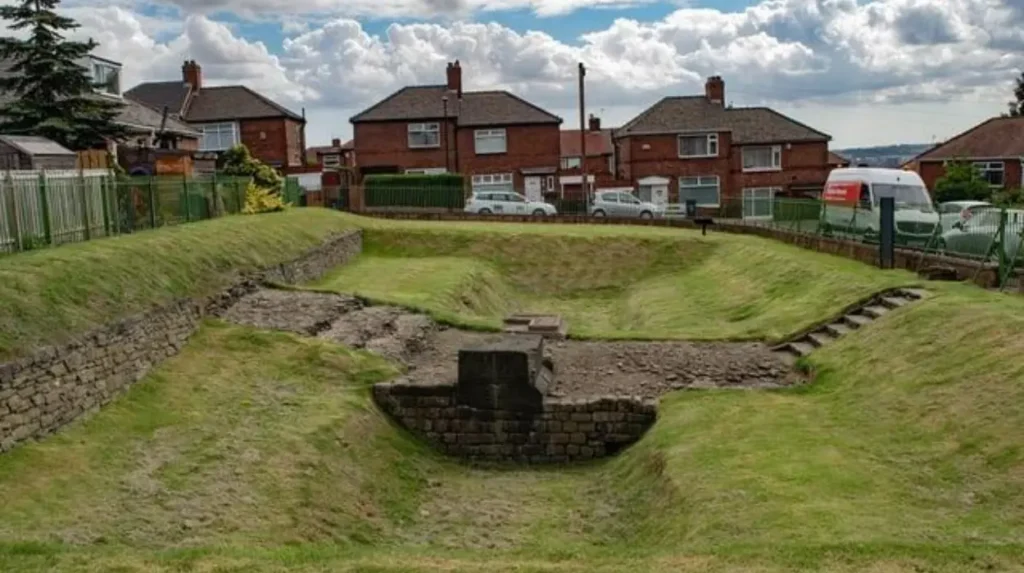
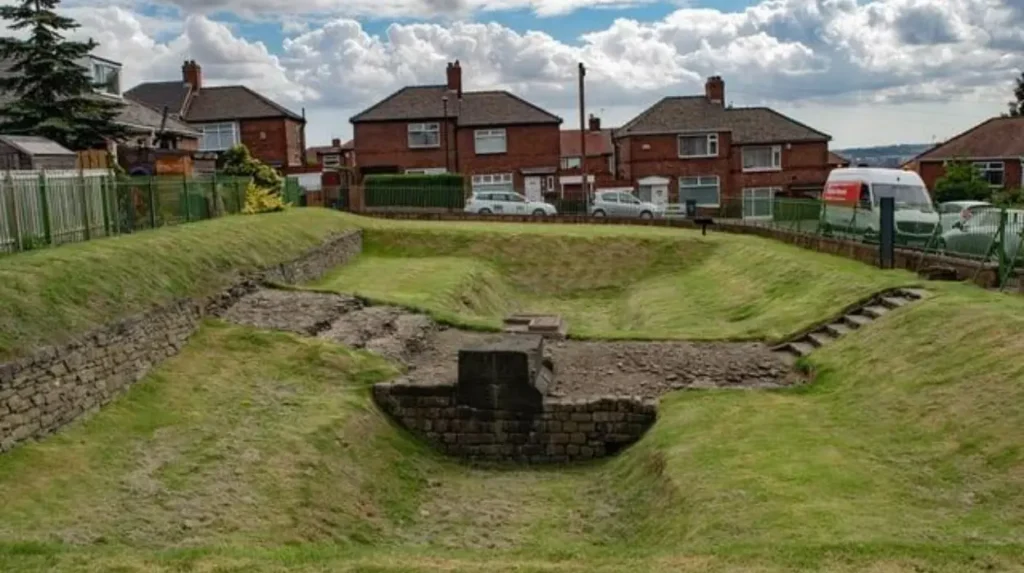
The Vallum was a substantial earthwork south of Hadrian’s Wall. It consisted of a broad ditch with raised banks and formed part of the controlled frontier zone. Access across it was restricted to designated crossings.
The Benwell Vallum crossing is a separate archaeological monument near the temple. It preserves a stone-built causeway where a road from the south crossed the earthwork on its way towards the fort. English Heritage identifies it as the only permanent Vallum crossing visible on the line of Hadrian’s Wall.
The crossing helps explain how movement was organised within the frontier system. The temple, meanwhile, provides evidence of religious activity in the same broader environment.
Can you visit the temple and Vallum crossing together?
Yes. The two monuments can be combined in a local heritage visit, provided you plan the short journey between their separate locations.
The temple is on Broomridge Avenue, while the Vallum crossing is in Denhill Park. The crossing’s official visitor postcode is NE15 6QH. English Heritage describes it as an open-access site for external viewing.
This combination provides two different perspectives on Roman Benwell: a religious building and an engineered route through the frontier landscape.
What Other Roman Sites Can You Visit Near Benwell Roman Temple?
Benwell Roman Temple sits within a wider network of Roman heritage sites across Newcastle and Northumberland. Nearby and regional examples include Benwell Vallum Crossing, Denton Hall Turret, Housesteads Roman Fort and Corbridge Roman Town, each illustrating a different aspect of frontier history.