


Key Points
- Manufacturing Deal for Historic Plant: The Siemens Energy plant in Byker, Newcastle, has won an important manufacturing deal to supply vital steam turbines for Rolls-Royce’s groundbreaking Small Modular Reactors (SMRs).
- First Steam Turbine Manufactured: This deal marks the first time a steam turbine unit will be manufactured for a small modular reactor across all of Europe.
- Deployed in North Wales: The steam turbines made in Newcastle will be installed in SMR units that will be deployed in North Wales on Anglesey.
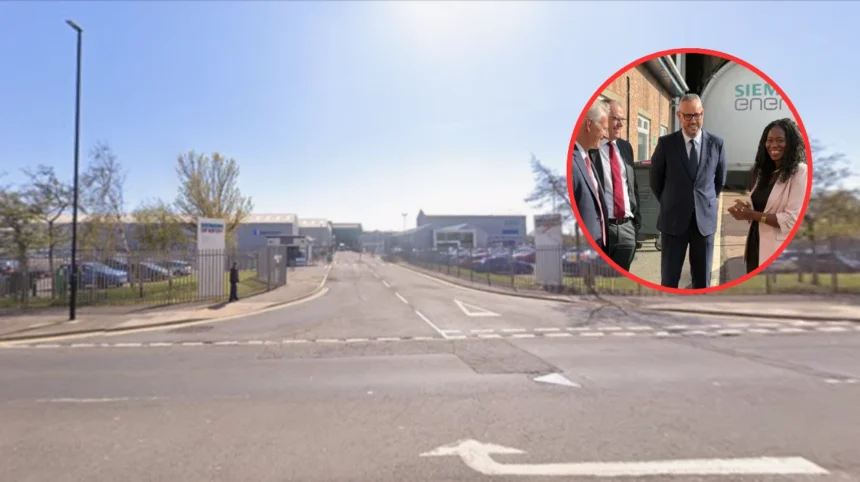
- Ministerial Recognition: Energy Secretary Miatta Fahnbulleh visited the Shields Road site and called it a clear example of the “golden age of nuclear” in the UK.
- Workforce at Site: This manufacturing site is located at the historic site that was established by Charles Parsons in the 1800s and currently houses 600 employees at the site, along with a host of new apprentices.
- Nuclear Power Legacy: The location boasts a history in the field of nuclear power as it manufactured the steam turbine for Calder Hall in West Cumbria, the world’s first nuclear power station that came online in 1956.
Newcastle (Newcastle Times) September 4, 2026 – Critical components for a major new United Kingdom nuclear power station are set to be manufactured in the North East, after the Siemens Energy facility in Byker secured a historic contract to build steam turbines for Rolls-Royce’s flagship small modular reactors (SMRs). The agreement marks a landmark milestone for the region’s manufacturing landscape, as it represents the first occasion that equipment of this specific nature will be produced for a small modular reactor anywhere across continental Europe. The SMR units currently under construction are earmarked for eventual installation on Anglesey in North Wales, directly linking Tyneside’s engineering expertise with the nation’s broader clean energy transition.
- Key Points
- What Is the Significance of the Siemens Energy Deal for Newcastle?
- What Did Energy Secretary Miatta Fahnbulleh Say During Her Visit to Tyneside?
- How Does the Byker Site Connect to the History of Nuclear Energy?
- How Will the Contract Impact Local Jobs and Apprenticeships on Tyneside?
- Where Will the Rolls-Royce Small Modular Reactors Be Installed?
The Shields Road site in Byker was visited by Energy Secretary Miatta Fahnbulleh, who toured the manufacturing lines to observe the preparation work and meet the engineering workforce. During the visit, Minister Fahnbulleh emphasized the strategic importance of the facility, describing the supply chain deal as a practical reflection of the government’s long-term nuclear strategy.
The Byker plant currently maintains a workforce of approximately 600 people on Tyneside. Regional employment in the advanced engineering sector is expected to receive a further boost as dozens of new apprentices prepare to join the Shields Road operations.
What Is the Significance of the Siemens Energy Deal for Newcastle?
The strategic agreement between Siemens Energy and Rolls-Royce positions Newcastle at the forefront of advanced nuclear manufacturing in Europe. By producing steam turbines specifically tailored for Small Modular Reactors, the Byker site establishes a commercial footprint in the global transition toward lower-carbon power generation.
Small Modular Reactors represent a shift in nuclear engineering, designed to be built in factory settings and assembled on-site to reduce capital costs and construction timelines compared to traditional, large-scale nuclear installations. The selection of the Shields Road plant underlines the facility’s specialized capability in heavy engineering and high-precision manufacturing.
As noted during the ministerial visit, embedding the production of core SMR components within Tyneside ensures that the UK supply chain retains high-value industrial operations locally. The steam turbines manufactured in Byker will serve as essential elements in generating electricity from the heat produced by Rolls-Royce’s nuclear reactors planned for North Wales.
What Did Energy Secretary Miatta Fahnbulleh Say During Her Visit to Tyneside?
During her tour of Siemens Energy’s Shields Road facility, Energy Secretary Miatta Fahnbulleh praised the site’s workforce and highlighted the broader economic benefits of expanding the domestic nuclear supply network.
As reported by the Local Democracy Reporting Service, Energy Secretary Miatta Fahnbulleh stated that the agreement demonstrated
“what our golden age of nuclear looks like in practice.”
Addressing the historical context and workforce capabilities of the region, Energy Secretary Miatta Fahnbulleh further told the Local Democracy Reporting Service:
“This part of the world has a huge history in engineering. We have good, high-skilled workers, and a history of training people up. The opportunity, for me, with reindustrialisation is this – it is using clean energy, which we know we need more of, building out a supply chain here in Newcastle. We want to see this and we need to see far more of it.”
The Labour minister’s remarks underscore the central government’s focus on linking green energy initiatives directly with industrial regeneration and workforce development in traditional manufacturing hubs.
How Does the Byker Site Connect to the History of Nuclear Energy?
The Siemens Energy site on Shields Road carries a continuous legacy of engineering achievements dating back to the 19th century. The works were originally established in the 1800s by the industrialist and engineer Sir Charles Parsons, whose invention of the steam turbine revolutionized modern energy generation and maritime transport.
The Byker facility played a pivotal role at the dawn of commercial atomic power. It was at this same Tyneside location that engineers constructed the original steam turbine for Calder Hall in West Cumbria. When Calder Hall commenced operations in 1956, it became the world’s first commercial-scale nuclear power plant to supply electricity to a public grid.
The new agreement to manufacture steam turbines for Rolls-Royce’s SMRs reinstates the Byker facility as a key contributor to civil nuclear infrastructure, linking its 20th-century history with modern nuclear technologies.
How Will the Contract Impact Local Jobs and Apprenticeships on Tyneside?
The deal provides commercial continuity for the roughly 600 employees currently based at the Byker plant. Beyond securing existing high-skilled engineering roles, the contract supports ongoing workforce development programs in the North East.
Siemens Energy has confirmed that dozens of new apprentices are set to join the Shields Road facility. These trainees will enter an environment focused on producing specialized components for clean energy projects, offering practical exposure to advanced manufacturing methods.
By anchoring major infrastructure contracts like the Rolls-Royce SMR project in Newcastle, the facility maintains its role as a key regional employer, preserving specialized trade skills and creating clear entry routes for early-career engineers.
Where Will the Rolls-Royce Small Modular Reactors Be Installed?
The steam turbines built in Newcastle are destined for installation in North Wales, where Rolls-Royce is developing its flagship SMR technology on Anglesey.
Anglesey has a long association with nuclear power generation, previously hosting the Wylfa nuclear power station, which operated from 1971 until its decommissioning in 2015. The deployment of Small Modular Reactors in North Wales is designed to utilize existing grid connections and local nuclear infrastructure expertise while supplying low-carbon electricity to the national grid.
The partnership between Rolls-Royce and Siemens Energy links Newcastle’s manufacturing capacity directly with Wales’s energy infrastructure requirements, illustrating how multi-regional supply chains are being structured to support the UK’s broader energy policy objectives.