

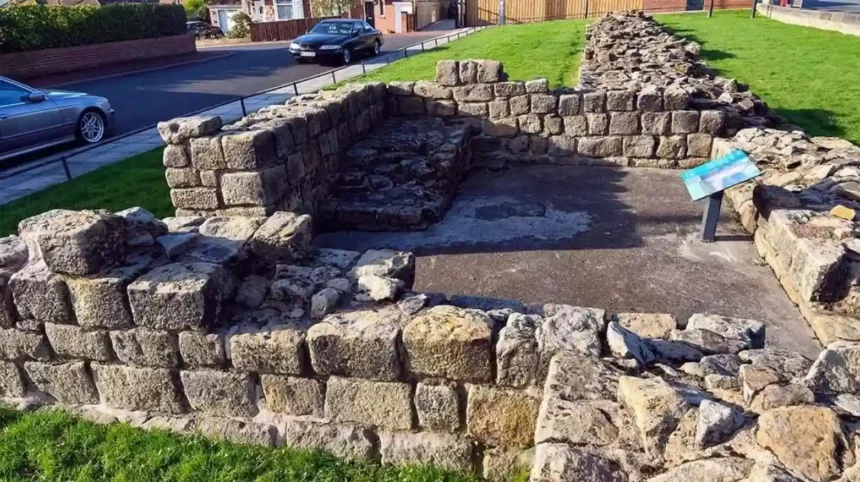
Denton Hall Turret is a Roman archaeological site on Hadrian’s Wall in West Newcastle, Tyne and Wear. Known as Turret 7b, it preserves the foundations of a Roman watchtower and an adjoining 65-metre section of the frontier wall. The site offers a convenient stop for visitors exploring Newcastle’s Roman heritage, with free entry during daylight hours and access beside the A186. Its location near the A69 makes it a practical introduction to Hadrian’s Wall before travelling further west into Northumberland.
- What Is Denton Hall Turret and Where Is It Located?
- When Was Denton Hall Turret Built and Why Was It Important?
- How Was Denton Hall Turret Designed and Used by Roman Soldiers?
- How Did Denton Hall Turret Fit Into the Wider Hadrian’s Wall System?
- What Did Archaeologists Discover at Denton Hall Turret?
- What Does the Inscribed Roman Stone Reveal About Denton Hall?
- How Can Visitors Reach Denton Hall Turret From Newcastle?
- Travelling by car
- Travelling by bicycle
- Travelling by public transport
- Is Denton Hall Turret easy to find?
- Is Denton Hall Turret Free to Visit and What Facilities Are Available?
- What Other Roman Heritage Sites Can Visitors Explore Near Denton Hall Turret?
- Benwell Roman Temple
- Heddon-on-the-Wall
- Wallsend and Segedunum Roman Fort
- How should visitors plan a Roman heritage route?
- Why Is Denton Hall Turret Important to Newcastle’s Heritage?
What Is Denton Hall Turret and Where Is It Located?
Denton Hall Turret is a surviving Roman watchtower on Hadrian’s Wall in East Denton, west of Newcastle upon Tyne. Also called Turret 7b, it stands beside the A186 at Turret Road, with free daytime access and remains of the adjoining Roman frontier wall.
The site is part of Hadrian’s Wall, the Roman frontier built in northern England during the second century AD. The turret stands approximately four miles west of Newcastle city centre, close to the A69 and the residential area of West Denton. Its official visitor postcode is NE15 7TH.
Denton Hall Turret is a small archaeological monument rather than a reconstructed Roman attraction. Visitors see surviving stonework, the outline of the turret and a short section of the original wall. Its modest size makes it suitable for a brief stop during a drive through western Newcastle or a longer historical journey along Hadrian’s Wall.
English Heritage looks after the site. The monument is also recognised through the national heritage protection system, reflecting the archaeological importance of the turret and its associated wall. Historic England identifies the turret as a Grade I listed structure, while the surrounding Roman remains form part of a scheduled monument.
The setting is urban rather than remote. Modern roads and buildings surround this surviving fragment of the Roman frontier, demonstrating how ancient archaeological remains exist within Newcastle’s present-day landscape.
When Was Denton Hall Turret Built and Why Was It Important?
Roman forces constructed Denton Hall Turret around AD 122 as part of Hadrian’s Wall, the frontier established under Emperor Hadrian. The tower supported surveillance and military duties along the northern boundary of Roman Britain, connecting local defence with a much larger frontier system.
Emperor Hadrian ruled the Roman Empire from AD 117 to 138. Work on Hadrian’s Wall began in AD 122, creating a defensive frontier across northern England from the River Tyne in the east to the Solway Firth in the west. The completed route extended approximately 117.5 kilometres, equivalent to about 80 Roman miles.
The wall formed part of a wider Roman military strategy. It regulated movement across the frontier, supported patrols and marked the northern limit of a major Roman-controlled territory. Its construction required substantial labour, stone, transport arrangements and coordination between military units.
Denton Hall Turret occupied an important position near the eastern end of the wall’s broad-wall section. This section was designed to measure 10 Roman feet, approximately 2.96 metres, across. The turret was integrated into that substantial stone structure rather than built as an independent tower.
The frontier was not simply a continuous barrier. Milecastles, turrets, forts, roads and earthworks worked together to support military control. Milecastles were small fortified gateways positioned at regular intervals. Turrets provided additional observation points between them.
Denton Hall Turret therefore represents one component of a much larger Roman engineering project. Its remains help explain how Roman military architecture extended beyond major forts into the landscape around settlements that later developed into modern communities.
How Was Denton Hall Turret Designed and Used by Roman Soldiers?
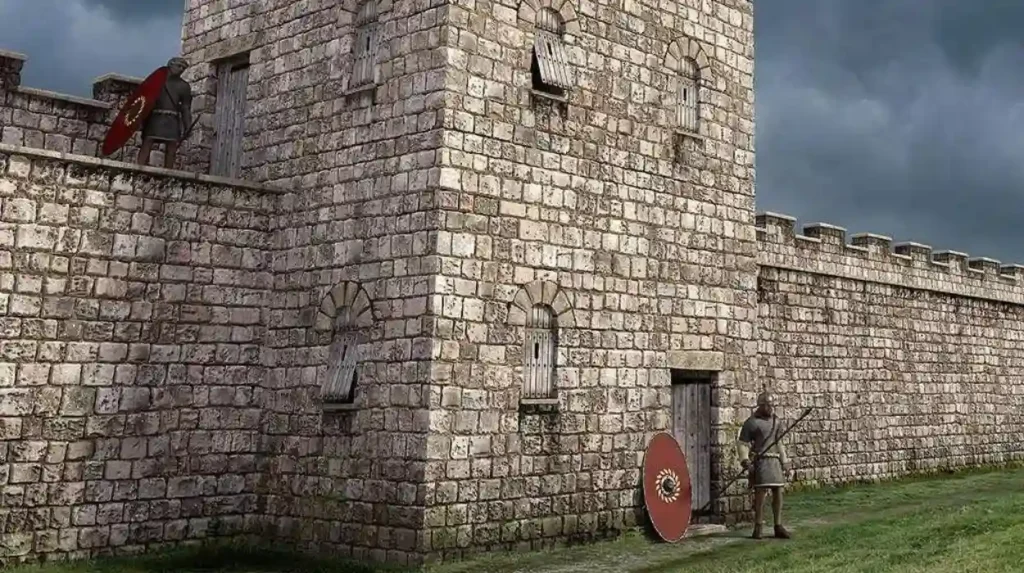
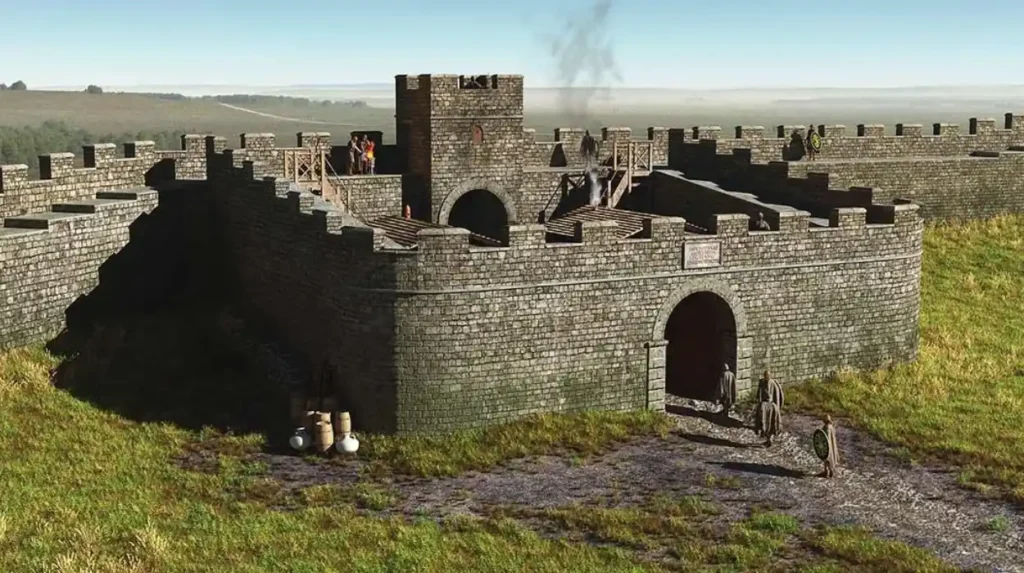
Denton Hall Turret was a small rectangular stone tower incorporated into Hadrian’s Wall. Its internal dimensions measured approximately 3.96 by 4.2 metres, with a doorway in the southern wall and a raised platform that supported access to an upper level for observation and military duties.
The surviving structure reveals how Roman engineers adapted a watchtower to the thickness of the frontier wall. Hadrian’s Wall formed the turret’s northern side, while the remaining walls enclosed the interior space. The ground floor was recessed into the wall itself, making the turret an integrated part of the defensive structure.
The entrance stood towards the eastern end of the southern wall. Inside, a stone platform and steps occupied part of the interior. Archaeologists interpreted these features as the base for a wooden staircase leading to an upper floor.
The upper level gave soldiers additional space and access to a sentry walk along the rear of Hadrian’s Wall. The original upper structure no longer survives, so its precise height and roof design remain uncertain. English Heritage explains that the turret probably had either an open upper platform with a parapet or a pitched roof.
The surviving walls reach approximately six courses of stone in places, according to Historic England’s listing description. A course is a horizontal layer of masonry. This limited height reflects the loss of the original structure over nearly two millennia.
The turret’s compact dimensions suited its role. It was a small military installation intended to accommodate a limited number of soldiers rather than a large permanent garrison. Soldiers used such structures for shelter, observation and duties associated with patrolling the frontier.
The remains also demonstrate the construction methods used along the broad-wall section. Large sandstone blocks formed the visible masonry, while the wall’s overall thickness provided a substantial structural base.
How Did Denton Hall Turret Fit Into the Wider Hadrian’s Wall System?
Denton Hall Turret formed part of a coordinated Roman frontier that extended across northern England. Hadrian’s Wall incorporated approximately 160 turrets, with two positioned between neighbouring milecastles, allowing soldiers to monitor movement and maintain communication across the defensive boundary.
Hadrian’s Wall was designed as a connected military landscape. Its principal components included the curtain wall, milecastles, turrets and major forts. The system also incorporated a large earthwork known as the Vallum, which ran south of the wall across much of the frontier.
Turrets were normally positioned at intervals of approximately one-third of a Roman mile, around 500 metres. Two turrets occupied the space between neighbouring milecastles. These arrangements created regular observation points along the frontier.
Milecastles provided controlled gateways through the wall and accommodated small groups of soldiers. Larger forts, such as those at Wallsend and Housesteads, supported larger military forces and more extensive operations.
Denton Hall Turret belonged to this network near Newcastle’s western edge. Its position illustrates how Roman military infrastructure extended beyond the principal forts and into the areas surrounding the River Tyne.
The wall also changed during its construction and use. Roman authorities modified aspects of the original plan, including the introduction of larger forts along the frontier. Archaeological evidence from individual sites helps researchers understand these adjustments and the different ways soldiers occupied the wall.
Why Was the Turret Numbered 7b?
Turret 7b follows the numbering system used to identify turrets along Hadrian’s Wall. The numbers relate to the nearest milecastle to the east, while the letters distinguish the two turrets associated with each wall mile. Denton Hall is the western turret of the pair identified as 7a and 7b.
This naming system helps archaeologists, historians and visitors identify individual remains along the frontier. It also allows evidence from different excavations to be compared without confusing sites that share similar local names.
What Did Archaeologists Discover at Denton Hall Turret?
Archaeological excavations at Denton Hall Turret in 1929 revealed evidence of repeated changes to its interior. Researchers identified three principal phases of ground-floor rearrangement, including earlier floor levels and hearths that demonstrate how Roman soldiers used the structure over time.
The turret was excavated under the direction of archaeologist Eric Birley, whose investigation documented the remains of the interior and its construction. Newcastle’s local archaeological records also document earlier work in the area during 1928 and the formal excavation in 1929.
The excavation identified three major periods of internal rearrangement extending from the original construction into the fourth century AD. During these phases, the floor was raised substantially. Evidence of hearths appeared at all but the final identified floor level.
A hearth is a prepared area used for heating or cooking. Its presence indicates that the turret served practical domestic functions in addition to observation and military surveillance.
The findings demonstrate that a Roman turret was not simply an empty lookout tower. Soldiers used the interior as a working space, adapting its layout as conditions and activities changed.
Archaeologists also recovered objects associated with activity inside the structure. English Heritage records two stone vessels among the debris shown in the published excavation material. Such discoveries contribute to understanding the daily routines of Roman personnel stationed along the frontier.
Excavation evidence requires careful interpretation. Archaeological deposits can be disturbed by earlier investigations, later construction and centuries of weathering. At Denton Hall, researchers recorded damage to some of the evidence, limiting the certainty of particular conclusions.
Even with these limitations, the excavation provides a valuable record of a small military installation within the Newcastle section of Hadrian’s Wall.
What Does the Inscribed Roman Stone Reveal About Denton Hall?
A Roman inscription discovered at Denton Hall in 1869 identifies the First Cohort of the Second Augustan Legion as the unit responsible for building a section of the wall. The inscription connects the local monument with the organised military labour behind Hadrian’s Wall.
The inscription reads L II AVG COH I FEC. English Heritage explains this as an abbreviation of Legionis II Augustae Cohors I Fecit, meaning that the First Cohort of the Second Augustan Legion built the relevant section.
The Second Augustan Legion, known in Latin as Legio II Augusta, was one of the Roman legions that served in Britain. Its involvement in the construction of Hadrian’s Wall forms part of the wider history of Roman military engineering in the province.
Inscribed building stones provide evidence that complements the physical remains. Archaeologists use them to investigate which military units worked on particular sections of the frontier and how construction responsibilities were organised.
These inscriptions are especially valuable because surviving masonry rarely identifies its original builders directly. A stone bearing a military inscription can connect a particular stretch of wall with the personnel responsible for its construction.
The discovery also demonstrates that Denton Hall Turret is significant beyond its surviving dimensions. Although only a small part of the structure remains, its archaeological record contributes to understanding the construction of the entire frontier.
How Can Visitors Reach Denton Hall Turret From Newcastle?
Denton Hall Turret lies approximately four miles west of Newcastle city centre, beside the A186 and near the A69. Visitors can reach the monument by car or bicycle, using the postcode NE15 7TH for navigation and checking local conditions before setting out.
English Heritage lists the official location as Turret Road, Newcastle upon Tyne, Tyne and Wear, NE15 7TH. Its published directions place the monument immediately south-east of the A69. The site is also identified on the National Cycle Network.
Travelling by car
Driving is a practical option for visitors incorporating the turret into a wider Hadrian’s Wall itinerary. The A69 connects western Newcastle with communities and heritage destinations further west. The A186 provides access to the area around the monument.
English Heritage states that on-street parking is available at the site. Visitors should check the signs and restrictions in force when they arrive, as parking conditions depend on the surrounding road layout.
The turret is beside a major road, so drivers should plan a safe stopping point rather than assume that every nearby space is suitable for parking.
Travelling by bicycle
The site is identified as accessible from the National Cycle Network. Cycling provides another way to explore the western suburbs of Newcastle and connect the monument with other historical locations.
Visitors should check their chosen route before departure, particularly where cycle routes meet busy roads. The direct surroundings are urban, and traffic conditions differ from those on quieter rural stretches of Hadrian’s Wall.
Travelling by public transport
Visitors using buses or other public transport should check current services to East Denton and West Denton before travelling. Routes, stopping points and timetables change, so a current journey planner is more reliable than relying on an old timetable.
Allow additional time to walk between the nearest suitable stop and the monument. Check the road layout carefully, especially when approaching the site from the A186.
Is Denton Hall Turret easy to find?
The official postcode is the most useful starting point for navigation. English Heritage also publishes the site’s coordinates as approximately 54.984515 latitude and -1.695694 longitude.
The monument is small and lies close to modern infrastructure, so visitors should look for the surviving stonework rather than expect a large visitor entrance or a prominent reconstructed building.
Is Denton Hall Turret Free to Visit and What Facilities Are Available?
Denton Hall Turret has free entry and is open at reasonable times during daylight hours, according to English Heritage. It is an open archaeological site rather than a staffed visitor centre, so visitors should prepare for uneven ground and limited on-site facilities.
English Heritage lists the attraction as free to enter. Its visitor information specifies reasonable daylight access rather than fixed daily opening times. This arrangement makes the monument suitable for a short visit during a broader exploration of Newcastle or Hadrian’s Wall.
Visitors should distinguish the site from larger heritage attractions that offer indoor exhibitions, ticket desks, toilets and refreshments. Denton Hall Turret is a small outdoor monument, and the visitor information does not advertise a full visitor-centre experience.
What should visitors wear?
Practical footwear is appropriate because the ground around historic masonry is uneven. Weather-resistant clothing is useful in Newcastle, where conditions can change during the day.
Visitors should avoid climbing on the remaining walls. The surviving masonry is archaeological fabric, not a recreational structure, and unnecessary contact risks damaging fragile historic material.
Is the site suitable for a short visit?
Yes. The visible remains occupy a compact area beside the road, making Denton Hall Turret suitable for a brief historical stop. Visitors interested in military archaeology can examine the wall’s construction and the turret’s position without planning a full-day visit.
People who require step-free access should assess the approach and ground conditions before travelling. English Heritage flags uneven surfaces in its visitor information, so access should not be assumed to be suitable for every mobility requirement.
What rules apply at the monument?
Visitors should respect the archaeological remains and follow the site’s guidance. English Heritage states that smoking, vaping, barbecues and naked flames are not permitted. Its visitor information also provides guidance on drone use.
Responsible visiting protects the monument and helps keep access available for future visitors. Avoid moving stones, disturbing the ground or leaving litter around the historic structure.
What Other Roman Heritage Sites Can Visitors Explore Near Denton Hall Turret?
Denton Hall Turret provides a starting point for exploring Roman Newcastle and Hadrian’s Wall. Nearby heritage locations include Benwell Roman Temple, while Heddon-on-the-Wall and larger frontier sites offer additional remains that explain the scale and organisation of Roman Britain.
The western edge of Newcastle contains several Roman archaeological sites that help explain the city’s position within the frontier landscape. Combining them with Denton Hall Turret gives visitors a broader understanding of the military and religious structures associated with Roman occupation.
Benwell Roman Temple
Benwell Roman Temple is associated with the local cult of Antenociticus, a deity worshipped in Roman Britain. English Heritage identifies the remains as a small temple in the area of the civilian settlement outside Benwell Roman Fort. The site demonstrates that Roman religious activity existed alongside military infrastructure.
The temple offers a useful comparison with Denton Hall Turret. The turret reflects frontier surveillance and military life, while the temple provides evidence of religious practices within the Roman settlement landscape.
Heddon-on-the-Wall
Heddon-on-the-Wall lies west of Newcastle and contains a substantial surviving stretch of Hadrian’s Wall. English Heritage describes this section as retaining the original planned width in a long, relatively unbroken length. A Roman milecastle was also located in the area of the present village.
Compared with Denton Hall Turret, Heddon-on-the-Wall helps visitors appreciate the continuous scale of the frontier wall. It is a useful addition for travellers who want to see more extensive masonry rather than a compact turret foundation.
Wallsend and Segedunum Roman Fort
Segedunum Roman Fort stands at Wallsend, near the eastern end of Hadrian’s Wall. Its location helps explain the frontier’s connection with the River Tyne and the wider Roman military network.
Wallsend provides a contrast with Denton Hall Turret because a fort accommodated a larger military establishment. The two sites represent different scales of Roman frontier infrastructure: a small observation post and a major fortified base.
How should visitors plan a Roman heritage route?
A practical itinerary starts with Denton Hall Turret, continues to Benwell Roman Temple and then extends west towards Heddon-on-the-Wall. Visitors interested in the eastern end of the frontier can arrange a separate trip to Segedunum at Wallsend.
These locations are not all part of one compact walking route. Check distances, opening arrangements and travel connections before setting off, especially when visiting multiple sites in one day.
Why Is Denton Hall Turret Important to Newcastle’s Heritage?
Denton Hall Turret preserves evidence of Roman military engineering within modern Newcastle. Its surviving masonry, excavation records and building inscription help explain Hadrian’s Wall, Roman construction practices and the relationship between the frontier and the communities that developed around it.
The monument provides a direct connection between Newcastle’s urban landscape and its Roman past. Its position in East Denton shows that important archaeological remains survive outside the city centre and beyond the larger, better-known Roman attractions.
The turret’s Grade I listing and the scheduled status of the associated archaeological remains reflect their historical importance. These protections help safeguard surviving fabric and archaeological evidence for research, education and public appreciation.
Denton Hall Turret also demonstrates how historians combine different types of evidence. The remaining stones reveal the building’s physical structure. Excavation records provide information about interior alterations and hearths. The inscribed stone links construction activity to a named Roman military unit.
Together, these sources contribute to a more detailed understanding of the frontier than the surviving structure alone provides.
For Newcastle residents, the site offers a local opportunity to explore Roman history without travelling deep into rural Northumberland. For visitors, it introduces the engineering and military organisation behind one of northern England’s most significant ancient monuments.
Denton Hall Turret is a brief but historically meaningful stop for anyone exploring Roman Newcastle. Its small scale does not diminish its importance as part of the wider story of Hadrian’s Wall.