

Key Points:
- The city of Newcastle prepares to celebrate its first NRL grand final since the year 2001, marking the period when the Newcastle Knights clinched the NRL premiership.
- The musician, Daniel Arvidson, reminisces about his 2001 parody song about the “big penis” (Queens Wharf Tower) that got demolished in 2018 due to urban regeneration.
- In the past 25 years, Newcastle has evolved from being an old post-industrial steel city to becoming a gentrified, safe, and expensive one.
- Notable locations within the area of Newcastle such as the old Civic railway station, industrial steel works at Mayfield, and many others including traditional pubs have already closed, destroyed, or regenerated.
- Between the late 1990s and early 2000s, local figures such as Daniel Johns (Silverchair) and Rugby League players Matthew Johns and Andrew Johns made Newcastle a household name all over Australia.
- The source used for this assignment is an article named, “The ‘big penis’ has been torn down: how Newcastle changed in 25 years since the Knights’ last NRL title”. This article was authored by Ben Smee and published by The Guardian.
Newcastle (Newcastle Times) September 30, 2026 – As reported by Ben Smee of The Guardian, more than 80,000 people witnessed musician Daniel Arvidson sing about Newcastle’s unorthodox local landmark known as the “big penis” at the city’s foreshore in October 2001. Arvidson’s track about their shared hometown circulated widely on local radio that year concurrently with the Newcastle Knights driving toward a second NRL premiership.
As noted by Ben Smee of The Guardian, Mr Arvidson recounted: “The station said: ‘we’ll play it every time the Knights get up’ and then the Knights just kept on winning.” Mr Arvidson performed the Newcastle-focused track three times at an official civic reception held for the triumphant sporting team.
As detailed by Ben Smee of The Guardian, the lyrical content was eagerly chanted by crowds, cataloguing the gritty, unvarnished elements of a working-class industrial city familiar to residents coming of age at the turn of the millennium. These included local tropes, 3am hamburgers, pub altercations, romantic interludes in car parks at the Strzelecki lookout, and the “orange shit in the sky” glowing from the steelworks operating in Mayfield.
What happened to the local landmarks immortalised in the 2001 anthem?
As highlighted by Ben Smee of The Guardian, the lyrics referenced local transit and sights, including:
“He got out at Civic station, walked across the lines / He saw the big penis, and said ‘where the fuck am I?’ / Newcastle whoaooooh / It’s so beautiful my dear / They can bury me here”.
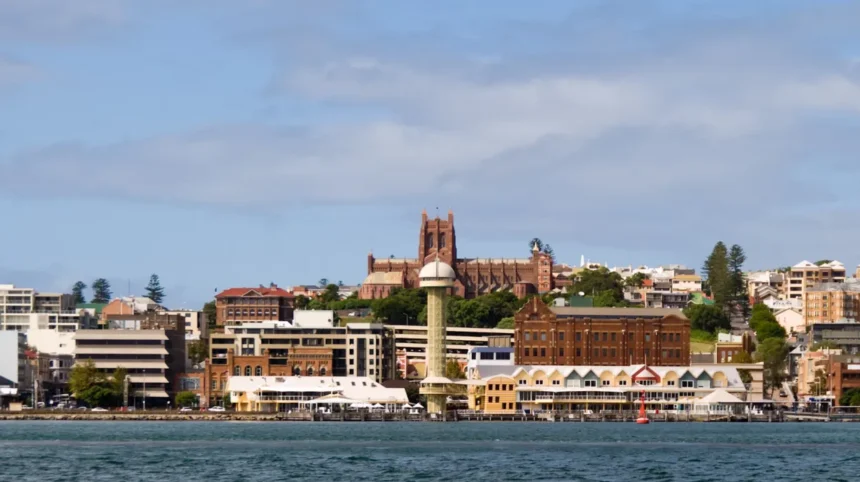
According to Ben Smee of The Guardian, authorities tore down the structure locally referred to as the big penis—officially the Queens Wharf Tower—in 2018. The tower was deemed an “embarrassment to the city” and removed under the banner of urban renewal. Furthermore, the nearby Civic station was left stranded years prior when heavy rail lines were dismantled amid controversy.
As reported by Ben Smee of The Guardian, numerous traditional pubs referenced in Arvidson’s song have since closed or been demolished. Suburbs like Islington and Carrington, once characterised by cautionary local adages to “lock your doors”, have undergone substantial gentrification to become trendy. Meanwhile, residents in the East End banded together in recent years to voice environmental and noise concerns regarding local Supercars motor racing events.
Explore More Local Newcastle News
Anant Ambani Conferred Sustainability Professorship at Newcastle University Newcastle 2026
Newcastle £20 Million Pride in Place Board Meets in Outer West Newcastle 2026
How does the modern Newcastle Knights grand final run reflect urban change?
As stated by Ben Smee of The Guardian, as the Newcastle Knights gear up for their first NRL grand final appearance in 25 years, the team represents a cityscape that looks and feels vastly different from the rough-around-the-edges municipality captured in Arvidson’s 2001 track.
As written by Ben Smee of The Guardian, the initial wave of Knights successes unfolded against an atmosphere of economic and industrial uncertainty regarding what a post-industrial future held for the steel city. Two decades later, working-class Newcastle has evolved to become safer, more outward-looking, and confident, though simultaneously significantly more expensive and exclusive.
As quoted by Ben Smee of The Guardian, Mr Arvidson stated:
“I deliberately wanted to tap into the locals’ experience, for people who have lived here all their lives, just to paint it in from a place where only they’re going to relate to.”
Mr Arvidson added:
“하지만 [However] those experiences we’re talking about, they don’t exist any more.”
When did Newcastle take centre stage culturally on the national and international stage?
As observed by Ben Smee of The Guardian, for a brief period around the turn of the millennium, grungy Newcastle briefly functioned as a cultural hub. Three teenage musicians became international sensations in 1994 while still attending Newcastle high school, having written hit music in a bedroom located in Merewether.
As reported by Ben Smee of The Guardian, the frontman of that band, Daniel Johns, shared a surname with two other young local figures, Matthew and Andrew Johns, who rose through the player ranks at the Newcastle Knights to become sporting superstars within a few short years.
Background of the particular development
The intersection of sport and urban sociology in Newcastle, New South Wales, highlights a profound generational shift. In 2001, the Newcastle Knights captured the imagination of a community grappling with the structural decline of its heavy manufacturing base, symbolised by the regional steelworks. Cultural touchstones of that era—such as local independent music, industrial haze, and working-class social rituals—formed the bedrock of local identity. Over the subsequent two decades, deliberate urban renewal projects, infrastructure restructuring (including the removal of heavy rail lines), and property market shifts transformed Newcastle from a gritty blue-collar enclave into a contemporary, service-oriented, and gentrified coastal hub, creating a stark contrast between the city of the 2001 premiership and the current 2026 grand final contender.
This sporting and cultural milestone is expected to amplify local civic pride and tourism, casting a national spotlight on Newcastle’s modern identity. For long-term residents and working-class communities, the renewed attention underscores ongoing tensions surrounding housing affordability, urban exclusivity, and the preservation of local heritage against the backdrop of rapid gentrification.